

It is a curious, yet not uncommon, paradox that an opera composer may initially approach a dramatic premise and its libretto with marked reluctance, yet, upon committing to the work, become so absorbed in the material as to make it entirely their own. A notable example of this is Pyotr Ilyich Tchaikovsky and his penultimate opera, The Queen of Spades (Pique Dame). Written by his brother Modest after Alexander Pushkin’s novella, the libretto introduces substantial alterations, differing sharply in tone from Pushkin’s terse, ironic original.
In his story Pikovaya dama (1834), Pushkin employs familiar ghost-story tropes—three winning cards, the dead Countess’s apparition, and a winking playing card—without ever confirming they are real. He keeps a dry, sceptical distance, leaving open the possibility that the supernatural events exist only in Hermann’s unravelling mind. Pyotr and Modest Tchaikovsky sweep away that doubt in their 1890 opera, treating her ghost and the secret of the cards as literal, inescapable forces of fate. The libretto also alters the cast to fit Romantic tragedy: Hermann turns from a cold fortune-hunter into a man destroyed by obsessive love, whilst the Countess’s poor ward, Lizaveta, becomes her aristocratic granddaughter, Lisa. Adding new figures such as Lisa’s wealthy fiancé, Prince Yeletsky, and her friend Polina sharpens the romantic conflict. Finally, whereas Pushkin concludes on an ironic, everyday note—putting Hermann in an asylum and marrying Lizaveta off to a suitable husband—Tchaikovsky chooses pure tragedy, ending with Lisa drowning in the Winter Canal and Hermann killing himself at the gaming table. Seeing much of himself in Hermann’s isolation and impossible love, Tchaikovsky identified so closely with the character that he famously wept while composing his death scene in 1890.
That willingness to reshape the story is just as evident in the Deutsche Oper Berlin’s revival of Pique Dame, which I saw on Friday, 13 November 2026—a fittingly ominous date for an opera steeped in superstition, fate, and a dangerous three-card gamble. Premiered on 9 March 2024, the production had originally been commissioned from Sir Graham Vick, who died in 2021 before he could finish it. Rather than scrapping the project, the house handed it to Vick’s close collaborator and protégé, Sam Brown, who kept his mentor’s creative team and worked from his initial ideas while shaping the staging himself. Now Artistic Director of the Nederlandse Reisopera, Brown has staged over thirty productions across major European houses, ranging from Parsifal to Gerald Barry’s The Importance of Being Earnest. This staging marked both his Deutsche Oper Berlin debut and his first time directing Tchaikovsky’s score.
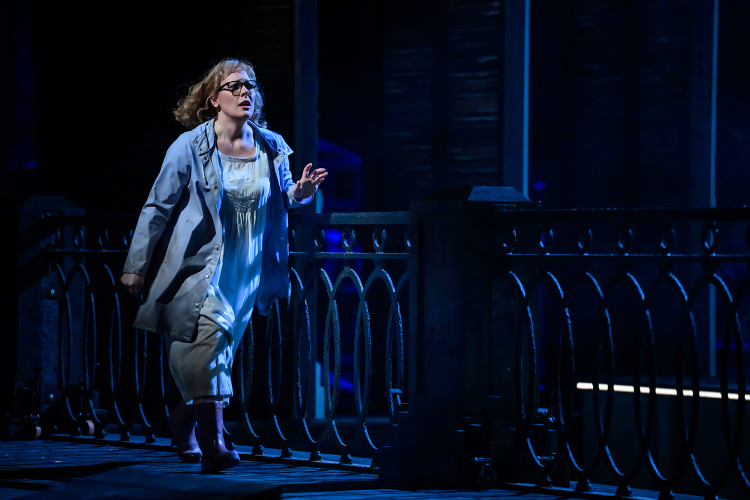
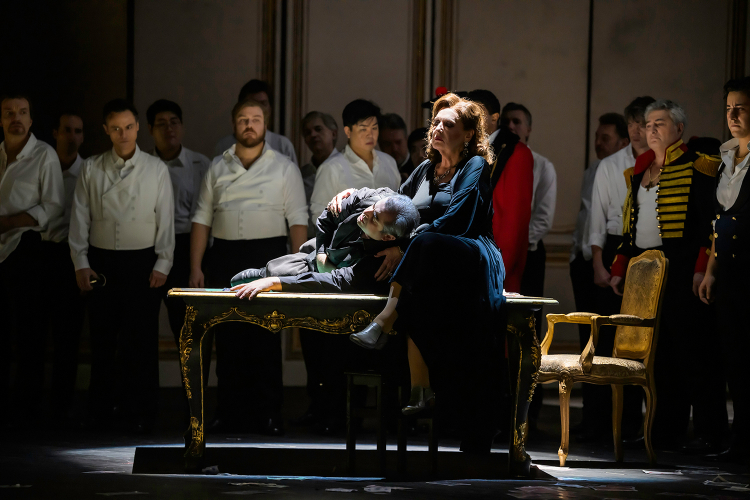
Moving a step further than the 1890 libretto, Brown reworks the drama as an intimate study of trauma and fixation. Juxtaposing past and present eras, the staging depicts a significantly younger and overtly sensual Countess alongside a newly invented childhood prologue in which Lisa—portrayed early on as a fellow social outcast in oversized spectacles and a curly wig—comforts a bullied Hermann. This emotional entanglement deepens during Hermann’s hallucination, when the Countess’s ghost appears clad in Lisa’s own light-blue ball gown, visually merging his devotion to Lisa with his fatal compulsion toward the three cards. Even Lisa’s death takes a stark new form: rather than drowning offstage in the Winter Canal, she plunges from a wall, leaving her corpse laid out upon the gaming table.
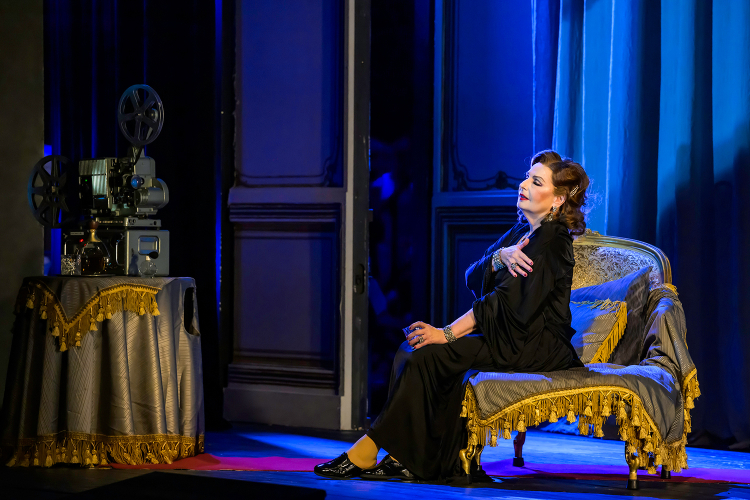
Stuart Nunn’s thoughtfully conceived sets and costumes prove finely attuned to each character’s social and psychological station, with the Countess dressed with patrician elegance, whilst Linus Fellbom’s sensitive lighting lends a brooding, atmospheric depth to the stage picture. To connect the literary source, the opera, and modern psychology, video designer Martin Eidenberger incorporates stills and footage from Yakov Protazanov’s 1916 Russian silent film adaptation throughout the evening, projecting imagery onto the curtain screen as the audience enters the auditorium and during the interval, as well as accompanying Tomsky’s ballad (‘Tri karty’) and Hermann’s confrontation in the Countess’s bedchamber. I found that these stills and film excerpts lent the production a welcome period cinematic quality, anchoring its modern psychological framing in the visual memory of old Russia.
The performance that I caught offered plenty to admire, featuring a luxury cast whose leads have sung these roles in other major opera houses.
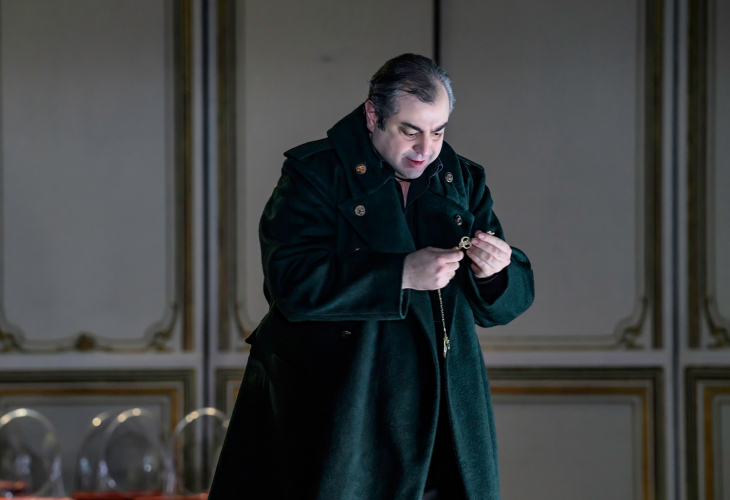
Making his house debut, Arsen Soghomonyan presented a dark, agonising Hermann. One could read his inner turmoil in his eyes and physical bearing. Vocally assured, he displayed only rare, sporadic traces of strain near the beginning, which did little to detract from his overall command of the role. Both his Act I aria, ‘Prosti, nebesnoye sozdanye’—in which he pleads for Lisa’s mercy, attention, and love—and his Act III, Scene 7 arioso, ‘Chto nasha zhizn’? Igra!’, were theatrically compelling and vividly sung. His tenor possesses a distinctive timbre and considerable expressive power. His Hermann seemed genuinely inhabited, characterised by moments of profound vocal and dramatic commitment, particularly in his scenes with Lisa.
Elena Guseva’s Lisa was distinguished, deeply felt, and sensitively sung. As a native Russian speaker, her diction was impeccable, and she shaped the text with innate musicality to convey the emotions of her sympathetic heroine. She embodied the character with the necessary innocence as well as emotional resilience, supported by a radiant, fresh voice and secure technique—culminating in a tormented and heart-rending account of her final arioso, ‘Akh! istomilas’ ya gorem’.
Doris Soffel, the veteran mezzo-soprano so widely admired in the works of Richard Strauss, offered a fascinating Countess, a clear departure from the interpretations to which we are accustomed. Gone was the frail, terrifying, chair- or bed-ridden old witch; instead, she drew upon the memory of the young heroine who conquered every man in her youth, crafting a femme fatale who, even at a comparatively advanced age, remains entirely capable of seduction. Her movement, facial expressions, and gaze were captivating at every turn. She imbued the characterisation with a sardonic humour and occasional flashes of wry comedy—most notably upon Hermann’s intrusion, when she attempts to entice him erotically, even offering him a glass of champagne. Her instrument remains well preserved, as demonstrated in her haunting rendition of the French air (‘Je crains de lui parler la nuit’), which captured an eerie, nostalgic, half-remembered quality. Moreover, she was ideally suited to this less vocally strenuous role.
Dean Murphy’s Prince Yeletsky—taking over the role from the originally announced Stéphane Degout—was impeccably poised and cut a strikingly elegant figure on stage. He captured both the character’s anguish and his sincere devotion to Lisa. His noble Act II, Scene 3 aria, ‘Ya vas lyublyu’, reflecting the hero’s quiet dignity and selflessness, was delivered with fine lyricism, eloquent legato, and careful attention to the long musical line.
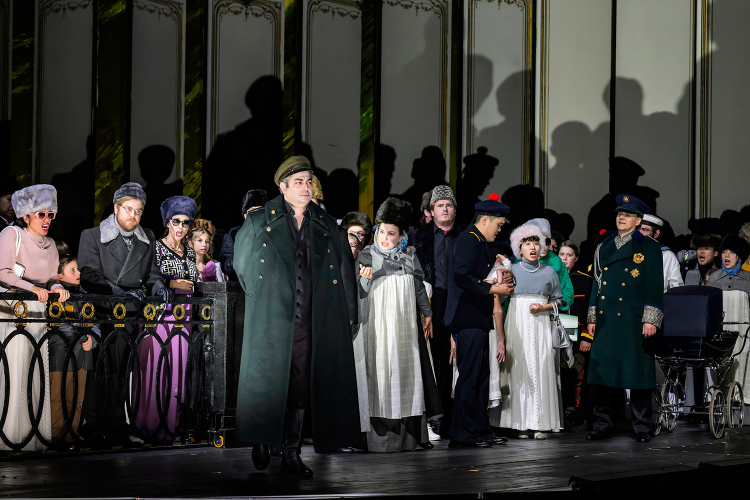
Roman Burdenko’s Count Tomsky—stepping in at short notice for Alexey Markov—made an equally strong impression. In his Act III, Scene 7 song, ‘Yesli b milyye devitsy’, he demonstrated the formidable capabilities of his well-schooled baritone alongside an infectious vitality, bringing great verve—backed by the robust men’s chorus of the opera house—to this spirited number about how helpless men would be if women could fly away like birds.
As Polina, Lisa’s loyal friend and confidante, Karis Tucker proved quietly assured, delivering her Act I, Scene 2 romance, ‘Podrugi milyye’, with an appropriately shaded, melancholic sensibility. Her rich, dark-hued mezzo-soprano sounded remarkably deep, velvety and well-rounded.
In the supporting roles, Michael J. Scott (Chekalinsky), Olymar Salinas (Chaplitsky), Michael Bachtadze (Narumov), Mark Kurmanbayev (Surin), Kathrin Göring (The Governess), Marlen Bieber (Masha), and Jörg Schörner (Master of Ceremonies) completed the cast admirably.
The Chorus of the Deutsche Oper Berlin and the Children’s Chorus of the Deutsche Oper Berlin—prepared respectively by Marco Medved and Christian Lindhorst—performed to a high standard. While the children’s chorus brought lively spirit and musicality to Act I, Scene 1, the main chorus projected a sonorous, well-disciplined sound across all three acts—proving particularly majestic in the Act II ball scene, after which the Deutsche Oper took its interval—and functioned as the dramatic pillar and emotional core of the opera. In the Act III gaming-house scene, the men’s chorus lent vigorous, resonant backing before delivering the opera’s final prayer, ‘Gospod’! Prosti yemu!’, in a hushed, deeply touching pianissimo.
In the pit, conductor Kirill Karabits led a reading of the score that uncovered all its subtleties and painful tragedy—thoughtful and unashamedly romantic, sustaining dramatic tension throughout the opera’s climactic set pieces and bringing chilling suspense to the Countess’s entire bedchamber scene, from her nostalgic French air to her fatal confrontation with Hermann. Under his direction, the superb Orchestra of the Deutsche Oper Berlin—bringing generous sonority, musicality, and a sure sense of style to every opera it performs—sounded full of character and wholly immersed in the narrative, playing with rich tonal colour and wholehearted commitment across the evening.
