

Richard Wagner originally conceived Der fliegende Holländer in 1841 as a continuous, single-act opera without intervals, aiming to break with operatic convention and preserve dramatic momentum. Ahead of its January 1843 Dresden premiere, however, he divided the work into three acts, largely to accommodate practical stage and scene changes. Today, opera houses regularly stage both the published three-act structure and the unbroken one-act version using linking orchestral interludes.
I previously attended a performance of this same opera at the Deutsche Oper Berlin on 28 January in Christian Spuck’s production, which originally premiered in May 2017 (you can read the review here). More recently, on 15 November, I had the opportunity to see the house’s controversial new staging by Milo Rau. At its premiere on 24 October, the production reportedly met with a mix of applause and boos, accompanied by a heavy police presence outside the theatre. During the performance I attended, however, there were no such demonstrations, and only a single boo was heard nearby just before the interval. Rau reimagines Wagner’s celebrated romantic tale as a ‘road movie’ centred on post-Holocaust German guilt and the Israeli–Palestinian conflict. During an August 2026 trip to Israel with his two narrators, Rau documented their journey and staged a public performance of Wagner arias in Tel Aviv, challenging a long-standing unwritten ban and provoking heated public debate.
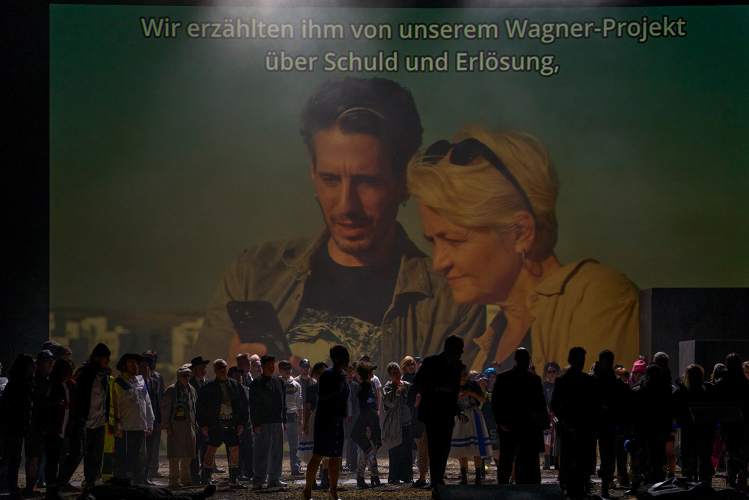
Before the performance begins, two narrators, Shlomi Moto Wagner and Sarah von Schwarze, are seated on opposite sides of the stage, with a framed portrait of Richard Wagner resting on a chair to the left. Simultaneously, video projections shot by designer Moritz von Dungern show the pair traveling through Israel and speaking with local figures. Shown throughout the evening, this recent footage highlights their intertwined backgrounds: Moto Wagner is an Israeli living in Germany, while von Schwarze was born in Germany to German parents and raised in Israel. On stage, both narrators were convincing, genuine, and sympathetic, doing their utmost to emphasise the production’s political message.
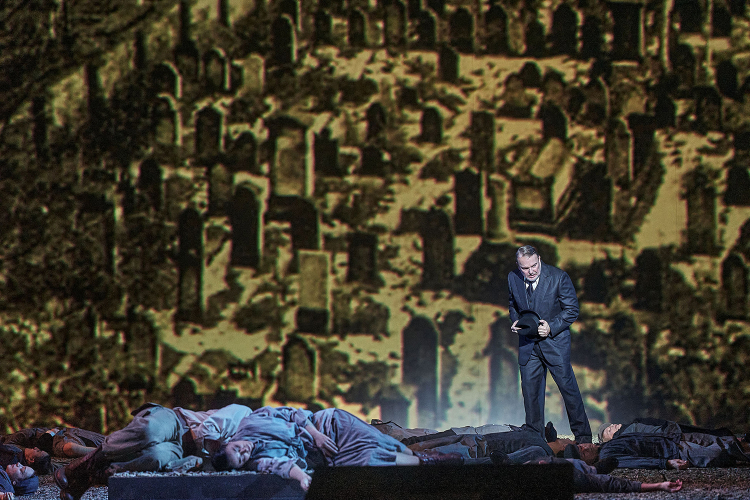
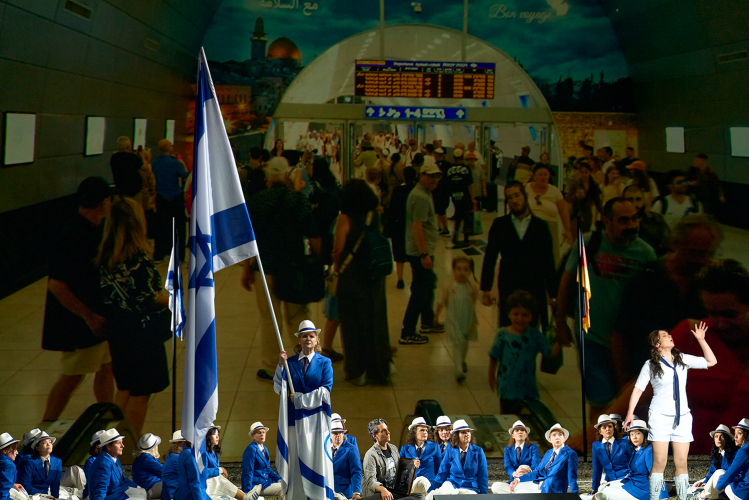
In Rau’s reading, the Flying Dutchman symbolises a Germany seeking redemption, while Senta represents Israel. She first appears as an athlete in the context of the 1972 Munich massacre, when Palestinian militants took eleven Israelis hostage, none of whom survived. Erik appears as a Palestinian figure present at the tragic event; by the end of the second act, the staging references Israeli Prime Minister Yitzhak Rabin’s 1975 visit to Germany. The second act concludes with the union of the Dutchman and Senta, flanked by the Israeli flag on the left and the German flag on the right. In the final act, set against the 2005 inauguration of the Holocaust Memorial in Berlin, Mary—traditionally Senta’s nurse and housekeeper, but recast here as an Israeli security agent—shoots Erik after discovering him attempting to strangle Senta, who wishes to give herself to the Dutchman.
I was among those who found Rau’s concept genuinely thought-provoking, even if its dense web of historical references demanded a great deal from the audience and at times crowded Wagner’s dramatic vision and music. By the conclusion, when Mary shoots Erik and Senta subsequently takes her own life, the dramaturgy felt overextended and emotionally exhausting. Silvie Naunheim (costume design), Anton Lukas (set design), Jürgen Kolb (lighting design), and Moritz von Dungern (video design) lent strong visual support to the production, aligning the stage aesthetics closely with the political narrative. Drawing on Gestapo leather coats, diplomatic suits, military fatigues, and a keffiyeh rather than traditional seafaring attire, Naunheim’s costumes firmly situated Rau’s staging in post-war German and Israeli-Palestinian history.
Musically, however, the performance achieved an exceptional standard, allowing Wagner’s score to speak with admirable devotion and dignity. Tomasz Konieczny is today among the most sought-after interpreters of the Dutchman, uniting a formidable voice with a commanding physical presence. Having initially sung the part twice in concert before staging it at the Deutsche Oper am Rhein during his 2006–2014 ensemble tenure, he has established it as one of his signature roles since debuting it at the 2021 Bayreuth Festival and performing it across major international houses. In Berlin, his dark timbre was ideally suited to the part, with dramatic leaps, low notes, and the upper register all securely placed. Possessing both the technical command and dramatic insight to convey the hero’s tormented nature, Konieczny gave every word its full weight. From his first entrance and opening Act I monologue, ‘Die Frist ist um’, he projected the unsettling intensity this haunting role demands, maintaining incisive declamation throughout and proving equally persuasive in his Act II duet with Senta.
Opposite him, Aušrinė Stundytė sang Senta with notable care and commitment. It is a taxing role, leaning heavily on the upper-middle passaggio and requiring a dramatic soprano capable of handling a wide, difficult tessitura right from the start. Making her role debut in this production, Stundytė brought out textual details and stayed fully engaged with the character, building Senta’s strong-willed determination up to the final moment. However, while her Act II Ballad (“Johohoe! Traft ihr das Schiff im Meere an”) did not lack heroic grandeur, the upper register turned momentarily insecure during its slower lyrical passages, and she occasionally pushed the voice over the course of the evening. Time will tell whether she settles more comfortably into the part.
Daland, Senta’s father, was portrayed by Tareq Nazmi, whose resonant bass, imposing stature, and sensitivity to the text brought considerable authority to the role. In this staging, the character is recast as a founding figure of the State of Israel, reframing his barter of Senta for the Dutchman’s gold as an allegory for the historical negotiations surrounding post-war German reparations.
The part of the huntsman Erik, Senta’s devoted former suitor, was sung and acted with compelling authority by Attilio Glaser, a member of the house’s solo ensemble. His securely placed, youthful timbre suited the character well, and he delivered his dream narration, ‘Auf hohem Felsen lag ich träumend’, with a clear grasp of its theatrical and prophetic weight.
Daland’s Steersman, a taxing assignment, was taken by Omar Mancini, also of the company’s roster, who phrased lyrically and possessed the stamina required for the high tessitura of the Act I solo, ‘Mit Gewitter und Sturm’. Natalie Lewis, an emerging artist who has recently succeeded in prestigious international competitions, made a strong impression in the brief part of Mary with her rich, rounded mezzo-soprano. She is clearly a singer to watch, with upcoming engagements that include Waltraute in Kirill Petrenko’s Die Walküre with the Berliner Philharmoniker next March in Salzburg and April in Berlin.
The Chorus of the Deutsche Oper Berlin appeared in excellent form. The women sang the spinning chorus, ‘Summ und brumm, du gutes Rädchen’, with crisp rhythmic precision. The men projected with striking power and focus in the opening sailor calls, ‘Hojohe! Hallojo!’, sounded robustly hearty in the Act III Sailors’ Chorus, ‘Steuermann, laß die Wacht!’, and discovered a haunting vocal colour in the Ghost Chorus, ‘Johohoe! Johohohoe!’.
The Orchestra of the Deutsche Oper Berlin ranks among the foremost orchestras globally, particularly in this repertoire, and its command of Wagnerian structure, style, and momentum was exemplary once again. Giedrė Šlekytė, drawing on the strength of these forces, conducted with theatrical flair, intelligence, and vigour from the tempestuous overture onwards, throughout displaying a keen ear for detail, rhythm and orchestral nuance.
