

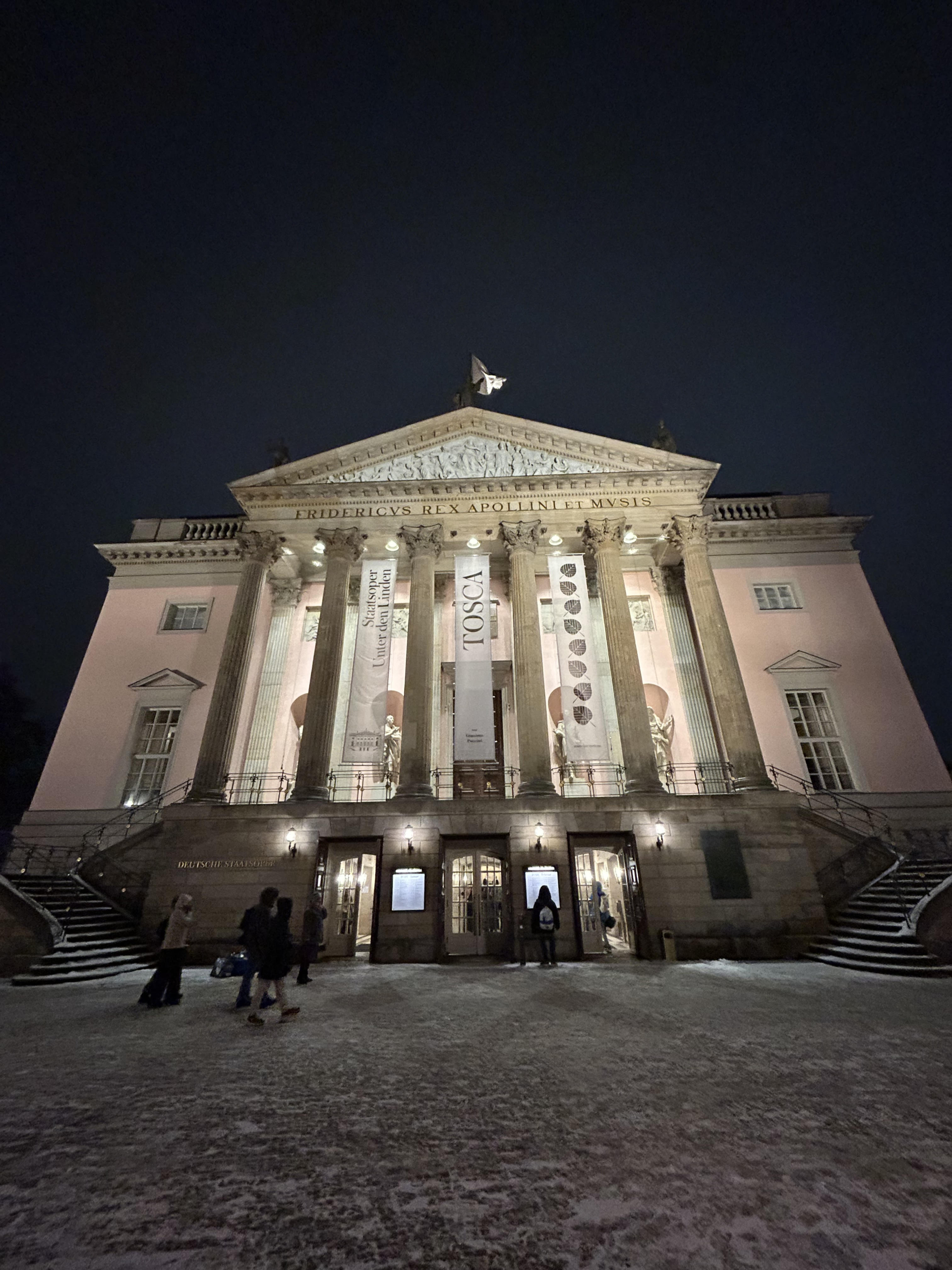
The Berlin State Opera (Staatsoper Unter den Linden), one of the world’s most historic opera houses, was founded in 1742 by Frederick the Great (the building construction began in 1741). The imposing edifice, dominates the Unter den Linden Avenue. After disasters suffered during the Second World War, it was reconstructed from 1951 to 1955. From 2010 to 2017, it was renovated and modernized (works cost 296 million euros).
In the main auditorium (capacity approx. 1,350 people), with its excellent acoustics and beautiful Rococo style decoration, I recently enjoyed two productions.
Tosca
On January 30, I attended Giacomo Puccini’s opera Tosca in a revival of the well-received production, first performed on 3 October 2014 at the Schiller Theater, which at the time housed the Staatsoper during the restoration of the Unter den Linden building.
The stage direction was signed by Alvis Hermanis, the sets and costumes, by Kristīne Jurjāne and the lighting, by Gleb Filshtinsky. José Darío Innella, assistant director, was responsible for the revival. Hermanis tastefully and thoughtfully chose to respect the libretto, carefully illuminating the characters and drama. He kept the action flowing and successfully moved the plot to the 1900s, during the time when the opera was first performed. At the end of the second act, he has Tosca showing Scarpia her thigh in a sexually attractive way and as soon as he comes close, she stabs him. After the murder, she drinks a glass of red wine and then, she pours a second glass, which she raises to victory.
Furthermore, I appreciated Jurjāne’s effective and functional sets, which during each act showed parts from the actual places in which the plot unfolds (first act, Sant’Andrea della Valle church, second act, Palazzo Farnese, and third act, Castel Sant’Angelo). Her costumes were elegant and Filshtinsky’s lighting design was apt.
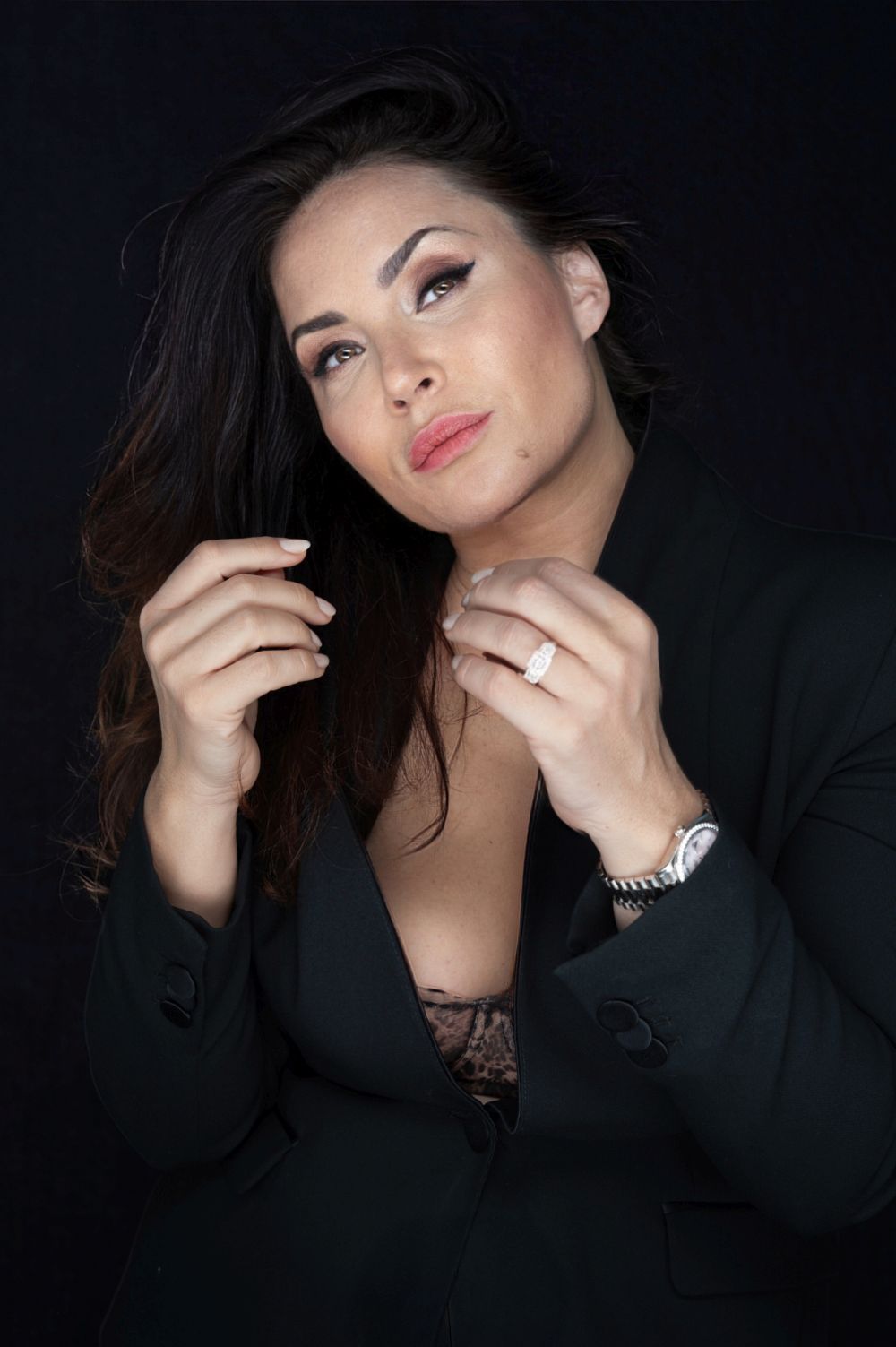
The luxurious cast was formed by a number of world stars. Sonya Yoncheva played the role of the tragic heroine a part that she has made very much her own since she first sang it on December 31, 2017, at the Metropolitan Opera in New York, after being called to replace Kristine Opolais. Since then, she has sung Tosca many times in famous opera houses. From the first moment of her appearance on the Berlin stage, you felt that she was ready to deliver a brilliant performance. She sang and acted with absolute conviction. Her effortless and velvety timbred voice was admirable. She offered a tragic and passionate Tosca until the terrible end of the opera, with some delightfully humorous touches during the first act when the diva, very much in love with Mario Cavaradossi, has difficulties in hiding her jealousy.
As the idealistic painter Mario, Vittorio Grigolo was outstanding, proving to be Yoncheva’s perfect match on stage. His singing and acting were superb. His warm voice and charismatic personality, the ease with which he sang the notes of the higher register, his musicality and his technical skill, were impressive from beginning to end.
In the role of Scarpia, Christopher Maltman’s performance was equally impressive. His imposing voice in volume and power, the meticulous artistry with which he phrased the music and the theatricality (I noticed the suggesting expression of his eyes) in which he portrayed the insidious, sinister, sadistic, and philandering character, were excellent. He paid great attention to the underlining of the text, reminding us of the fact that he is one of the finest Lieder singers of our time. It is worth mentioning that he belongs to those special singers who can move with great ease between roles of different repertoire and style; in the past I have admired him in roles by Wolfgang Amadeus Mozart, composer whom he enthusiastically honored from the beginning of his career, but also in parts belonging to operas written by Richard Wagner, Giuseppe Verdi and Richard Strauss.
In the supporting roles, equally satisfying were Carles Pachon (Angelotti), Hanseong Yun (Neokoros), Florian Hoffmann (Spoletta), Irakli Pkhaladze (Sciarrone) and Alexander Meier (shepherd).
The orchestra carefully executed details of the gripping score. Both the choir and the children’s choir stood at a high musical level and in the first act Te Deum sang with grandeur.
The conductor (and pianist) Giuseppe Mentuccia, a former assistant to Daniel Barenboim, supported the singers with care and illuminated the drama, while encouraging the orchestra to offer moments of sophistication and genuine passion.
Lohengrin
Always at the Staatsoper, on February 1, I attended a performance of Lohengrin by Richard Wagner, who, as usual, wrote both libretto and music, the premiere of which was conducted by Franz Liszt (Weimar, 28 August 1850).
The work revolves around the mysterious knight of Graal, Lohengrin, who first appears in a boat dragged by a swan. He has arrived in order to defend the innocent and pure Elsa. The latter, accused by the insidious couple Friedrich von Telramund and Ortrud, of killing her brother.
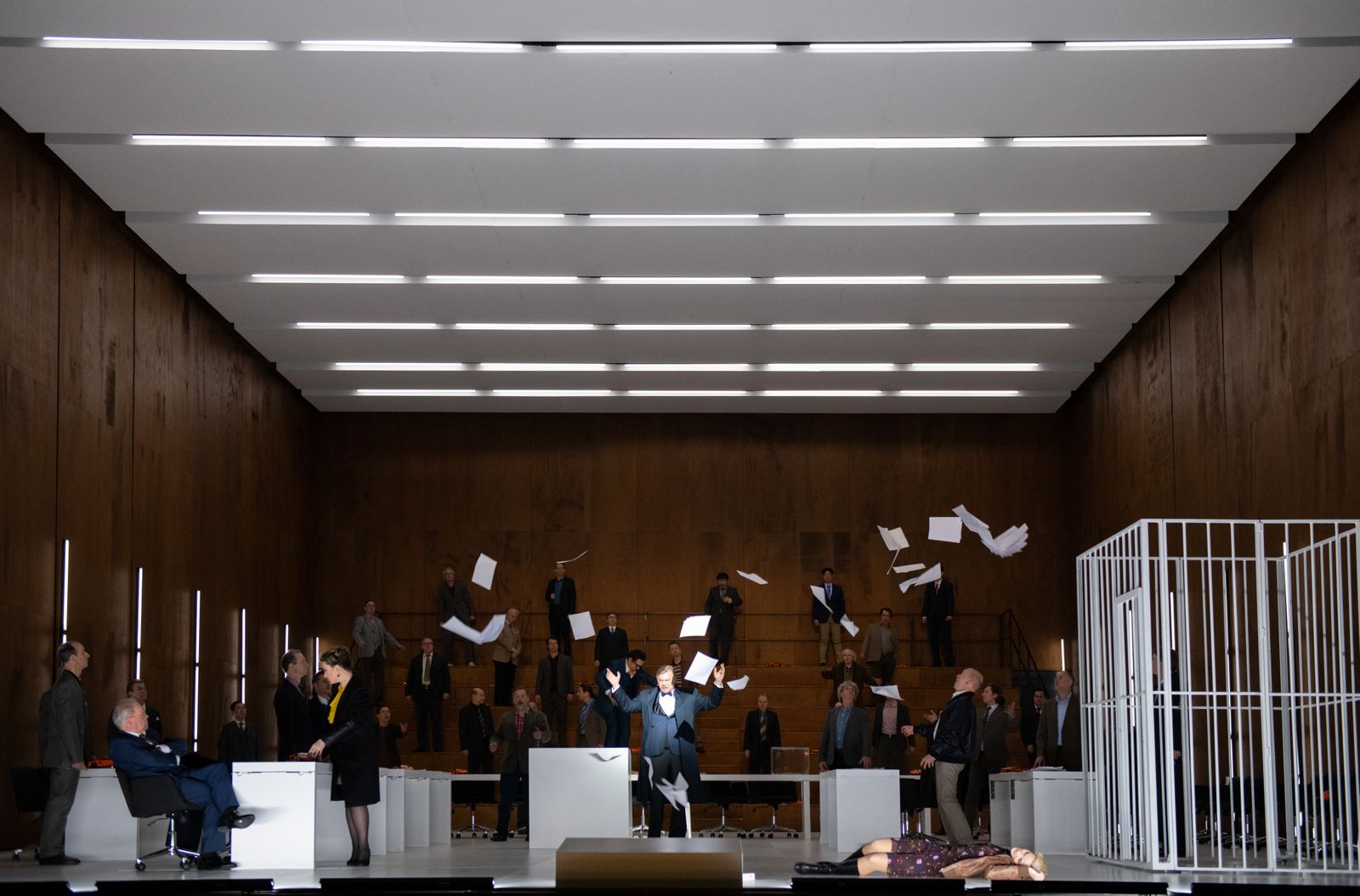
The Berlin production, first seen at the same theatre on December 13, 2020, during the Covid-19 pandemic, belonged to director Calixto Bieito. Rebbeca Ringst was the set designer, Ingo Krüler was the costume designer and Michael Bauer was the light designer. Bieito certainly has his own special views on the work. He sets the plot in the present day and moves away from the expected romantic context of the original libretto unfolding in the 10th century. He renders the work within a deconstructive framework, focusing on the dark and sometimes cruel, thriller-like elements. He makes the most out of Sarah Derendinger’s intriguing video projections, featuring the famous swan of the plot along with various disparate faces and scenes. There are times when the audience is confronted with surprising elements. Some appear in the third act: during the famous Prelude, we watch on film random and constantly changing sequences of black and white cinema and a little later, during the wedding scene, with the celebrated wedding march, the footage presents a black woman bringing life to a white swan (which according to the original story is her brother Elsa, transformed by Ortrud). In another scene, we see Ortrud kicking a plastic wedding cake with anger. Earlier, the duet of act 2, between Elsa and Ortrud, acquires a lesbian hue. At the end of the opera, Lohengrin holds an origami paper swan.
The roles were covered by an excellent team of distinguished singers.
The part of Lohengrin was played by Benjamin Bruns, who replaced Eric Cutler. Bruns has added several important Wagner roles to his repertoire. With his lovely lyrical voice, which easily manages to fill the opera house, he proposed an interpretation of great sensitivity, refined musicality and intellect.
Elza van den Heever was emotionally profound and moving as Elsa. She sang with generosity of expression and a fresh, appealing voice that in the high register acquired a special glow.
The veteran bass René Pape, an exquisite Wagner singer whom one is always delighted to admire on stage and in recordings, offered an imposing King Heinrich der Vogler. Following many years of performing, his voice remains in fine shape, maintaining its rare characteristics, its beautiful colour and a remarkable endurance throughout the vocal range.
Two other singers who have distinguished themselves in major Wagner roles, Wolfgang Koch and Anja Kampe, were equally exemplary, respectively in the roles of Telramund and Ortrud. Koch’s distinctive as well as rich bass-baritone voice and his attention to the illumination of the text had much to offer.
Kampe as Ortrud, in this demanding role usually performed by dramatic mezzos, but also sometimes by dramatic sopranos such as herself, was first class. She thrillingly entered the world of the malicious and ambitious sorceress taking full advantage of her fabulous vocal and theatrical arsenal. In the second scene of act two, during the Entweihte Götter! (“Profaned Gods!”) Kampe was epic, letting her voice soar through the house and impressing her audience. During the same act, darkening her voice, she was thoroughly convincing in the way that her Ortrud lured Elsa by manipulating her, planting the seed of doubt and making her wish to find out Lohengrin’s identity, even though he had made it a condition to his beloved, never to be asked about it.
Arttu Kataja, as the King’s Herald, sang with a resounding voice and played with plenty of theatrical temperament. Bieito had him look as a figure reminiscent of the horror film Joker.
The choir, which has a major part in this opera, was magnificent and provided high-energy singing. It was worthy of many praises, especially the male section.
Finally (last but not least!), in the pit, Simone Young, one of the most remarkable female conductors of our time, who has successfully conducted all the major works of Wagner and was the first maestra to lead the Ring in Bayreuth, provided a superb reading, precise and with a great sense of drama. She extracted from the stunning orchestra (the Staatskapelle Berlin) a compelling, nuanced and intense reading, full of fire (e.g. Prelude to Act 3) and warmth. How could one ever wish a better orchestra for Wagner?
