

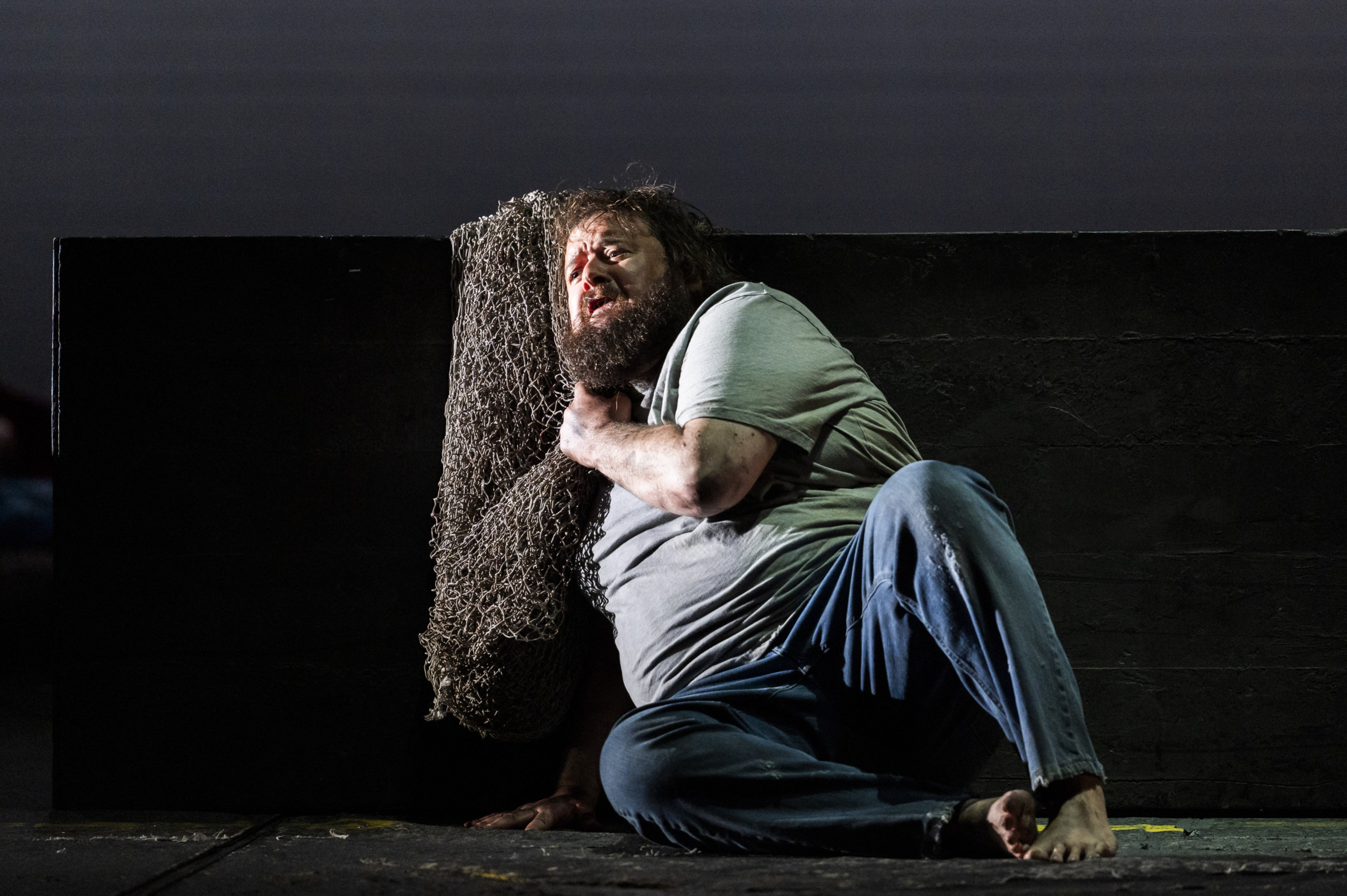
Allan Clayton portrays Peter Grimes. Picture by Tristram Kenton
“Peter Grimes! Peter Grimes!”, the mob’s chant in Act III, Scene I, remains one of the most chilling sequences in opera. Having already convicted the fisherman in their minds for the disappearance of his second apprentice—following the death of the first—the townspeople hunt him down like an animal. It is a terrifying portrait of community malice.
Since its 1945 premiere at Sadler’s Wells, Benjamin Britten’s masterpiece has held an uninterrupted grip on the global stage.
This first revival of Deborah Warner’s 2022 production shifts the action to contemporary times, uncovering a raw, psychological undercurrent in the work. Michael Levine’s bleak, evocative sets and Peter Mumford’s cold lighting amplify this uneasy atmosphere. Surreal visual motifs ground the staging’s dreamlike horror—most notably a fishing boat suspended like a weapon over Grimes’s head, and a silent, flying aerialist who floats through the interludes as a manifestation of the lost boy or Peter’s own breaking mind.
Tenor Allan Clayton portrays Grimes as a man trapped by his own psychological demons in a deeply human performance. Having sung the role across Europe and America, Clayton has completely made it his own. His immense vocal control operates alongside an imposing physical presence, but his true mastery lies in revealing Grimes’s delicate flaws, drawing a deep sense of pity for the character’s natural innocence. The final breakdown into madness is utterly shattering.

Maria Bengtsson, possessing a beautifully refined Mozartian soprano voice, sang the character of Ellen Orford, the Borough schoolmistress, with tenderness and compassion. During her Embroidery Aria in Act III, Scene 1, and the pivotal “Let her among you without fault” in Act II, Scene 1, she skillfully emphasised the resentment and disillusionment born from the community’s double standards in the former, and heartfelt grief and anguish in the latter.
Every return of Sir Bryn Terfel to the Royal Opera House stage is met with immense expectation—and not without reason. He brought a commanding presence to Captain Balstrode, instantly grounding the production with his rich, multi-layered bass-baritone. Through his performance, he powerfully captured a steady faith in Peter’s innocence, fiercely shielding him from the town’s blind fury with a stark, unyielding realism.
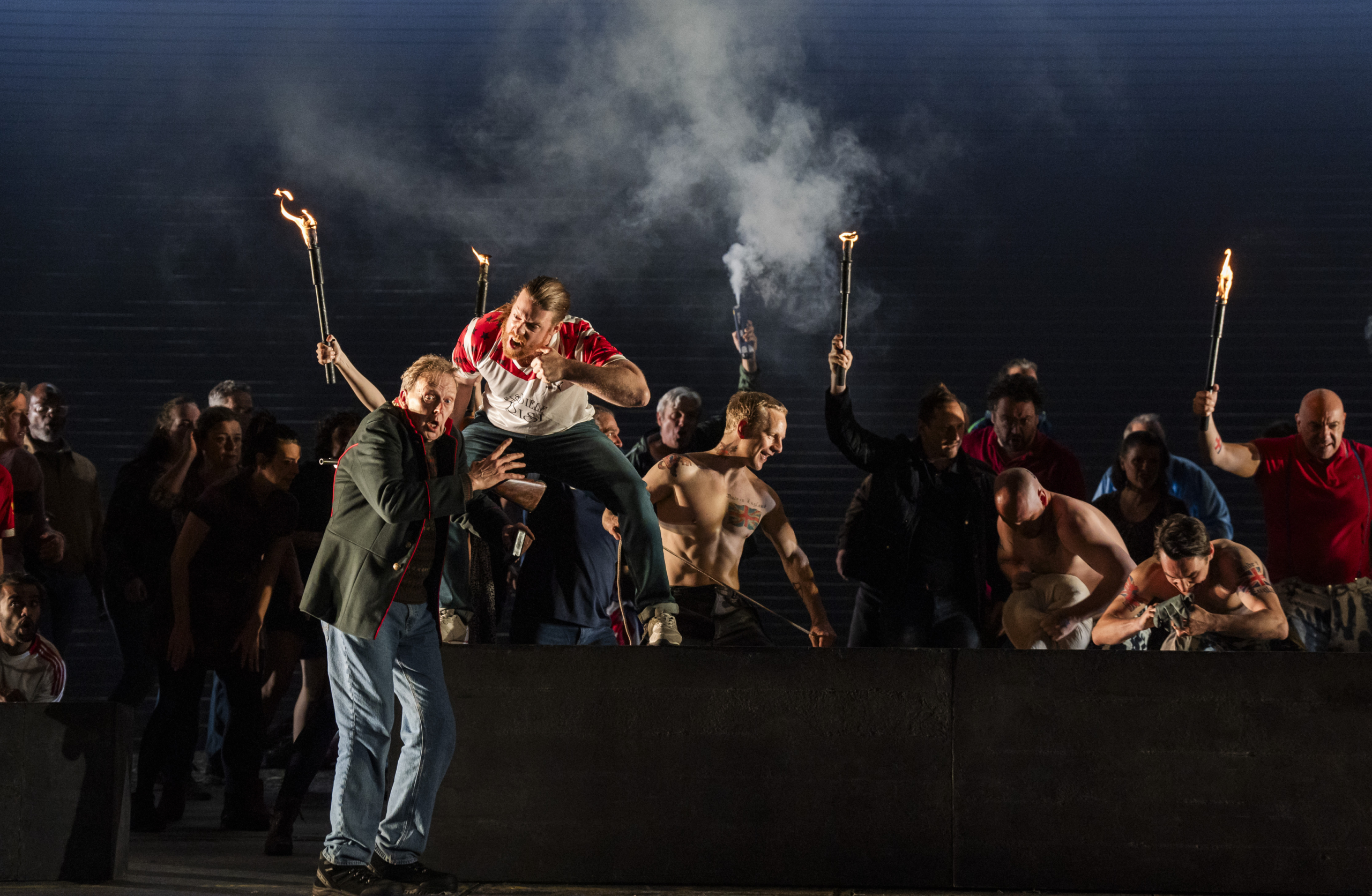
The supporting cast brings sharp, distinct identity to the village hypocrites and outcasts. Christine Rice’s judgemental Mrs Sedley, Clive Bayley’s authoritarian Swallow, and Catherine Wyn-Rogers’s weary Auntie are all expertly drawn. Jacques Imbrailo stands out as the apothecary Ned Keene, infusing the stage with a slick, theatrical energy. He plays Keene not just as a bystander, but as the transactional engine of the tragedy—the man who procured the ill-fated second apprentice.
The Royal Opera Chorus was in spectacular form, capturing all the visceral energy of a community warped by blind prejudice. Their singing carried a fierce, localised fury, backed by a massive wall of sound that felt genuinely threatening. The Act I delivery of “Home! To the West!” unfolded beautifully, as did a haunting “Old Joe Has Gone Fishing” and the off-stage church scene in the following act.
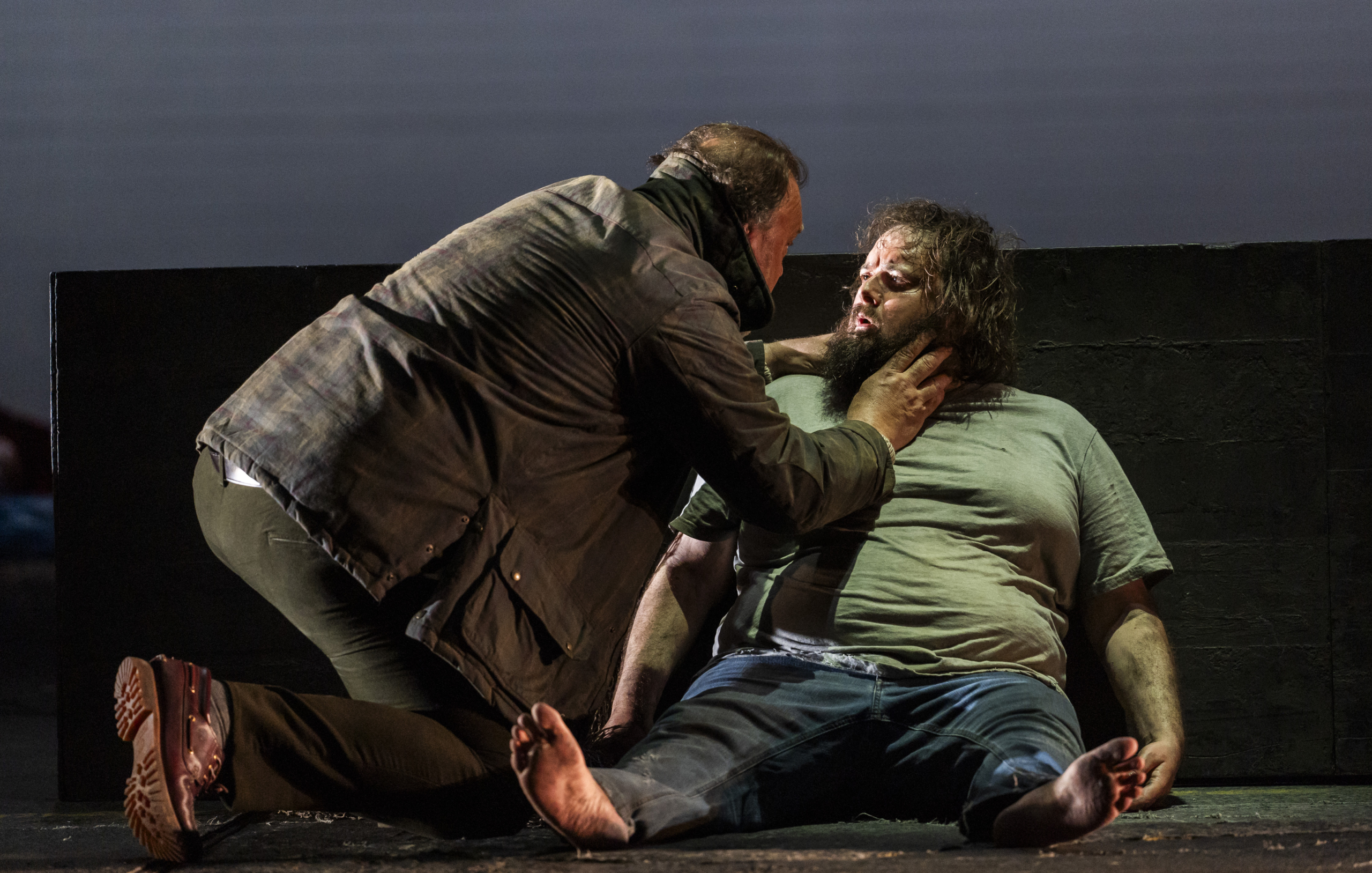
Playing the apprentice, Toby Higgins made a strong impression in a silent role, using subtle, hesitant physical movements to expose the young boy’s underlying terror.
Under Jakub Hrůša, The Royal Opera’s incoming Music Director, the reading was highly detailed. He dug deep into Britten’s score, pulling out buried instrumental textures from the Orchestra of the Royal Opera House to lay bare the psychological tension of the village.
When Clayton’s broken outsider finally disappeared and drowned, the audience was left in a state of shock. Warner’s final image—the spectral aerialist fading into darkness—offered a perfect, haunting balance of physical grit and surreal grace. Clayton has proven himself the definitive Grimes of this era. Driven by Hrůša’s incisive conducting, this gripping revival signals a thrilling new chapter for The Royal Opera.
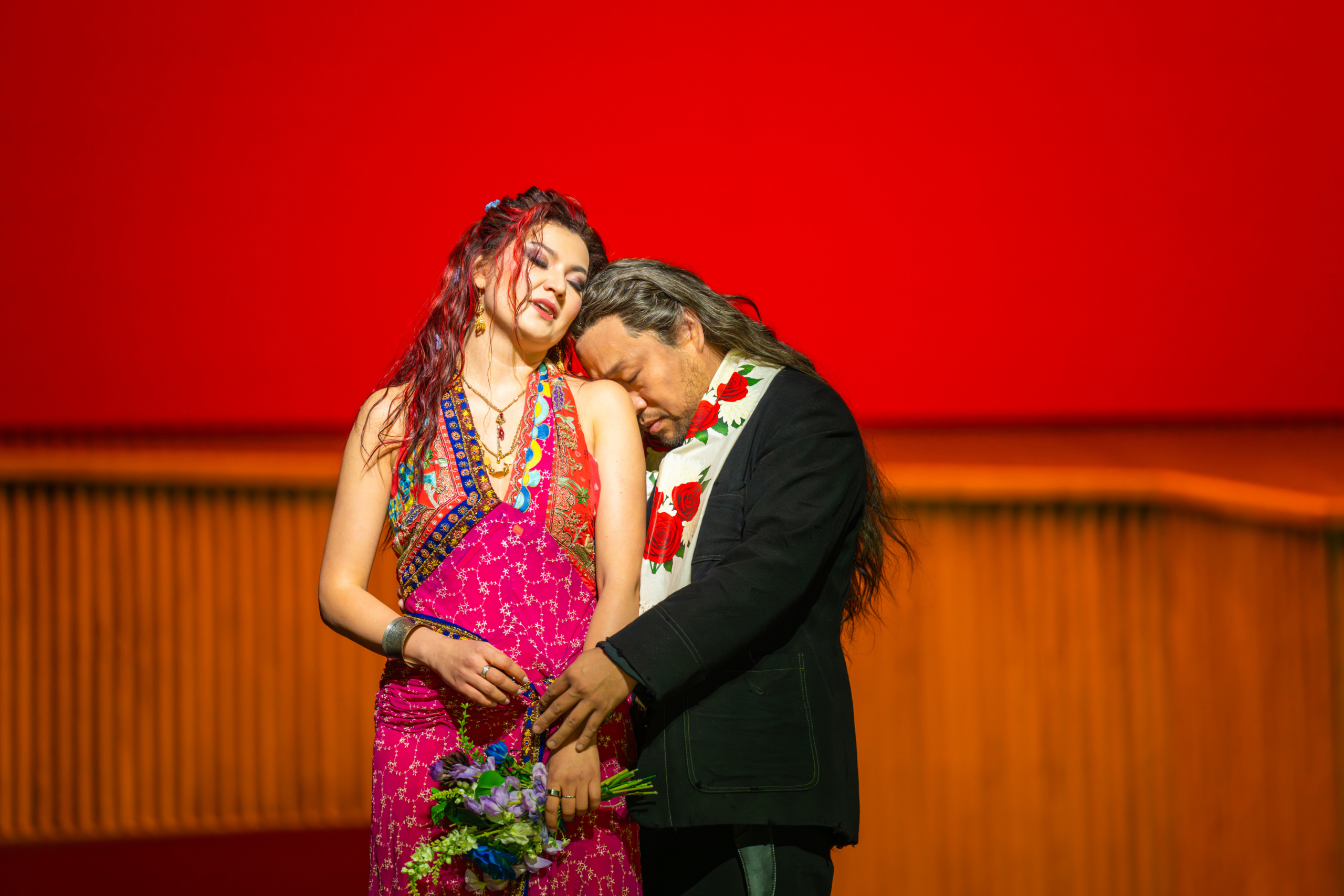
Aigul Akhmetshina as Dalila and SeokJong Baek as Samson. Picture by Mihaela Bodlovic
Following, on May 19, this same stage bore witness to the psychological and physical collapse of another seminal operatic protagonist: Samson. In a compelling parallel to Peter Grimes, Samson—the nascent political and spiritual leader of Israel—is systematically reduced to a marginalised outcast, subjugated and derided by a hostile collective. Both figures epitomize the archetype of the alienated, tragic hero whose existential suffering finds resolution only through self-willed destruction. This structural and thematic symmetry extends to the composers’ respective canons; just as Peter Grimes represents Britten’s definitive contribution to the twentieth-century operatic stage, Samson et Dalila remains the most enduring and widely performed masterpiece of Camille Saint-Saëns.
This revival reimagines the biblical narrative within a modern setting. The final act shifts to an ostentatious casino—a transformed temple of Dagon—where the ballet injects frenzied energy into the famous Bacchanale, completely breaking with the nineteenth-century classical choreography of Saint-Saëns’ era.
Aigul Akhmetshina made a highly anticipated debut as the seductive and malicious Dalila, a role that feels tailor-made for her lush, warm voice and stunning stage presence. With a creamy vocal texture, rock-solid technique, and exquisite expression, she brought out the full beauty of Dalila’s celebrated arias: “Printemps qui commence”, “Amour! viens aider ma faiblesse”, and, above all, a magical “Mon cœur s’ouvre à ta voix”.
SeokJong Baek’s vulnerable Samson stood no chance against her enthralling presence and magnetic singing, making his ultimate downfall feel entirely inevitable. Samson is hunted by his enemies (the Philistines), hunted through seduction (Dalila), and, as a fallen hero, hunted by regret and guilt. Baek possesses a remarkably compelling instrument and handles it beautifully, utilising a secure technique to shape his musical lines and master his vocal colour. The absolute highlight of his performance was “Vois ma misère, hélas!” in Act III—an incredibly moving moment that felt heavy with despair and genuine tragedy. The harrowing sight of his bleeding, blinded eyes only heightened the dramatic impact.
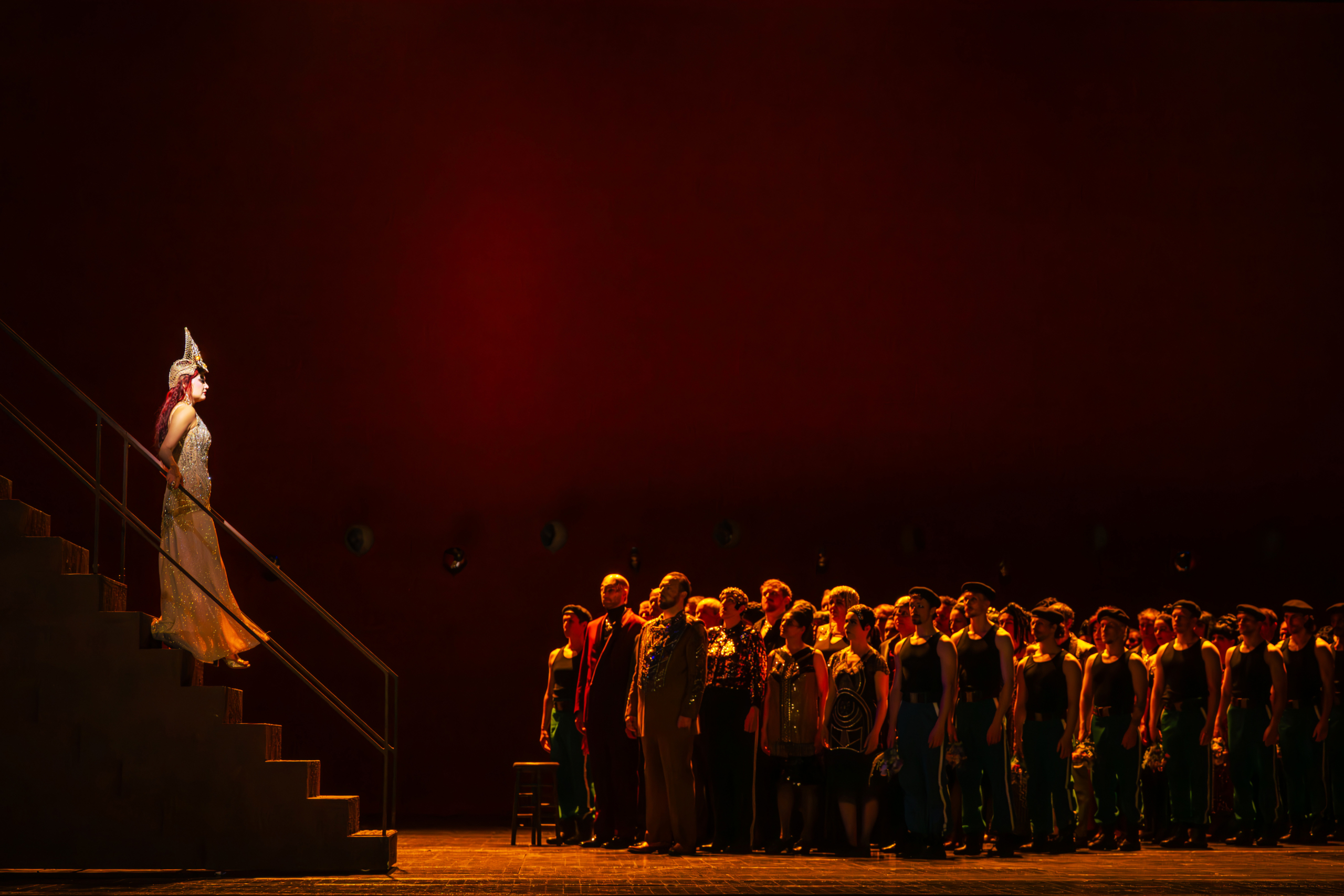
The shorter roles were no less successfully performed, rounding out an altogether extraordinary musical evening. Special praise must go to Łukasz Goliński’s authoritative High Priest of Dagon and William Thomas as Samson’s Rabbi. Ossian Huskinson delivered a memorable Abimelech, while Emmanuel Fonoti-Fuimaono, Siphe Kwani, and Emyr Lloyd Jones provided excellent support as the First Philistine, Second Philistine, and Philistine Messenger respectively.
The chorus remains the structural anchor of the opera, providing a clear link to its early development as a planned oratorio. The Royal Opera Chorus was magnificent, unleashing a formidable wall of sound and rendering the intricate counterpoint of the first act with exceptional transparency.
Conducting with a composed and assured hand, Alexander Soddy allowed the orchestra to shine, gracefully balancing the emotional contrasts and colourful textures of Samson et Dalila’s elegant orchestration without ever rushing the tempo.
Carried by superb performances, these back-to-back revivals serve as a powerful testament to the company’s current artistic vitality.
