

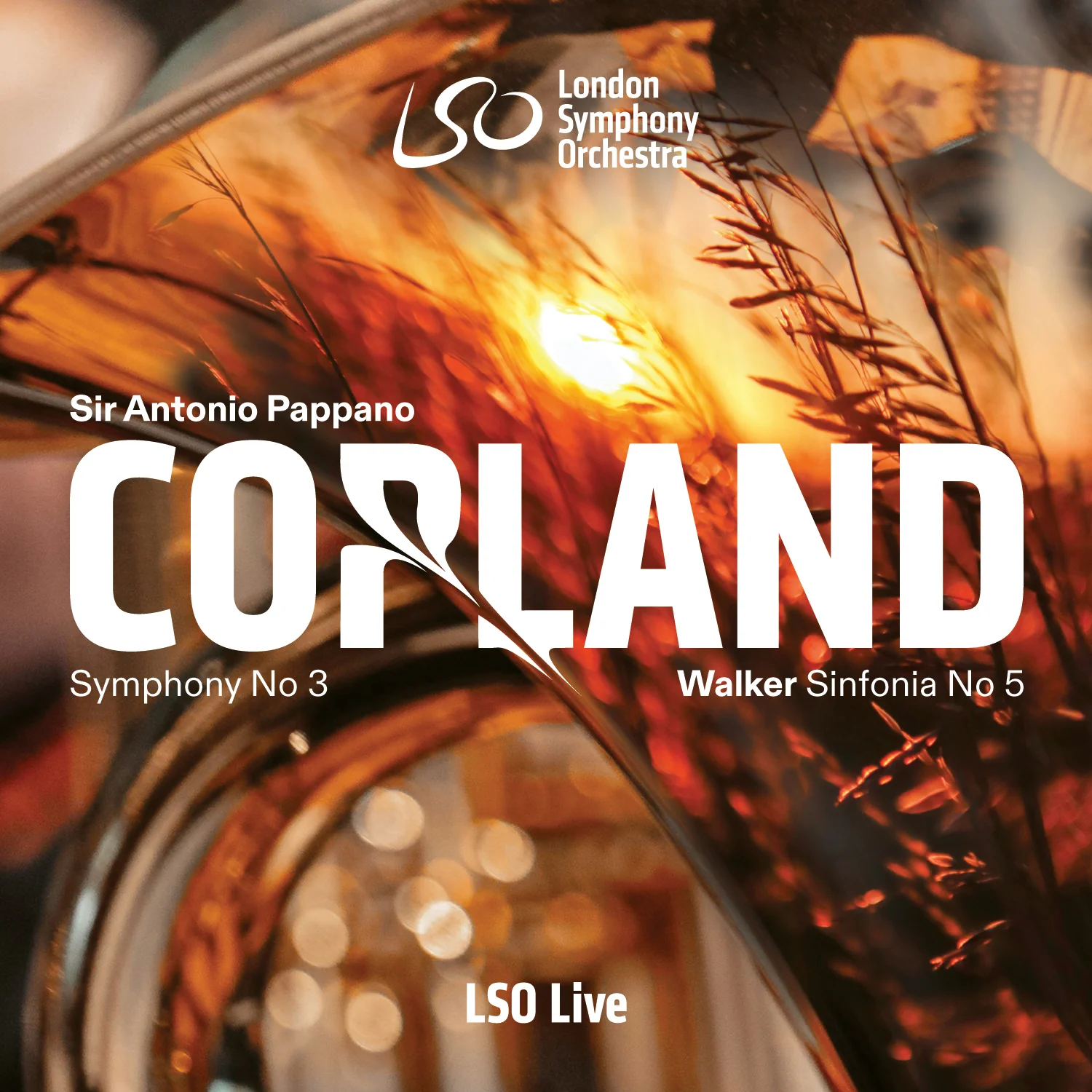
In an insightful pairing for its proprietary label, the London Symphony Orchestra juxtaposes two formidable compositions by iconic American composers.
Aaron Copland began composing his Symphony No. 3 in 1944 while staying in the serene village of Tepoztlán, his beloved Mexico. Residing there as a cultural ambassador to Latin America, he found a peaceful refuge from the tensions of the Second World War. This environment allowed him the time and focus needed to organize and write his elaborate score. He completed the work on September 29, 1946, in New Hampshire—just in time for its premiere on October 18 of that same year by the Boston Symphony Orchestra. The performance was led by music director Serge Koussevitzky, who famously lauded the score as “the greatest American Symphony ever written.”
The LSO and Chief Conductor Sir Antonio Pappano recorded the symphony in concert at Barbican Hall on September 14 and 17, 2025, during the second season of the conductor’s tenure. For listeners of my generation who first discovered this piece through Leonard Bernstein’s deeply emotional, documented 1985 account with the New York Philharmonic at Avery Fisher Hall—released on Deutsche Grammophon—this new rendering is a landmark event. Though the work is now frequently programmed and recorded, this current performance beautifully captures all the imagination, technical brilliance, and profound soul of Copland’s affecting music.
It is well known that the LSO was one of Copland’s favourite orchestras. This mutual affection resulted in the treasured discography of a number of his works for Columbia Masterworks (now Sony Classical), including this very symphony.
In this new interpretation, the LSO and Pappano offer a warmly committed reading. The hymn-like opening of the first movement, Molto moderato, is broad and expansive, revealing deeply moving moments of cantabile phrasing. The peaceful melodic lines float effortlessly to the surface, and the overall structural climaxes are handled with meticulous care and passion. The rhythmic vitality of the second movement, Allegro molto, features stellar contributions from the brass and woodwinds. Meanwhile, the mystical, melancholic atmosphere of the third movement, Andantino quasi allegretto, is delivered with exceptional emotional focus and orchestral detail.
The final movement, Molto deliberato – Allegro risoluto, opens with the composer’s celebrated Fanfare for the Common Man, written earlier in 1942. It is magnificently executed here, striking the perfect imposing and majestic tone, while passages of quiet introspection are treated with equal delicacy. Pappano masterfully balances the music’s engaging simplicity with its sophisticated harmonic and metric textures—such as the polytonal chord structures, syncopations, and frequent metre changes. Wisely, the original ending that suits the overarching form best is followed according to the latest 2015 revised edition published by Boosey & Hawkes, rather than the alternative version featuring the late-stage cuts made after Bernstein found the initial coda too grandiloquent.
The finely produced album concludes with Sinfonia No. 5, “Visions”, the crowning achievement by the acclaimed African American composer and pianist George Walker. Completed in 2016, it was his ultimate musical testament before passing away in August 2018 at age 96. Walker forged the piece out of deep grief following the June 2015 tragedy in Charleston, South Carolina, where a white supremacist took the lives of nine Black parishioners inside the historic Emanuel AME Church.
The LSO and Pappano delve ardently into the work’s angst-driven core. They deliver a performance charged with tension and scope, highlighted by a strong narrative, a prominent role for the piano (the composer’s own instrument), bold rhetorical statements, and thrilling, Stravinskian syncopated chords. Balanced by instances of profound compassion under Pappano’s baton, the musicians fully embrace the dramatic elements and momentum of the score to brilliant effect.
