

It is an unassailable fact that Richard Wagner’s colossal tetralogy has generated continuous, and frequently fiery, intellectual and emotional discourse worldwide. Der Ring des Nibelungen, lasting approximately fifteen hours and spanning a prologue and three successive evenings, has profoundly captivated international audiences from its inaugural complete performance at the Bayreuth Festival in August 1876 to the present day.
Given its massive duration, inherent complexities, and demand for highly specialized dramatic voices, the work presents unique production exigencies. Crucial to understanding this scale is Wagner’s connection to ancient Greek drama; he intentionally structured his masterpiece to mirror the enduring weight of Aeschylus’s Oresteia. By mapping the tragic, multi-generational curse of the House of Atreus onto the Norse gods and the theft of the Rhine gold, Wagner elevated his mythological source material into a universal human epic.
Consequently, stage directors are continuously tested by the sheer depth of Wagner‘s philosophical, psychological, and sociological inquiries, all of which are thoroughly rooted in classical ideals of fate, inherited guilt, and morality. In this regard, the Deutsche Oper Berlin holds a distinguished legacy of presenting pioneering interpretations of the cycle.
Heinz Tietjen set an early milestone for this style in the 1930s. His avant-garde cycle, designed alongside Emil Preetorius, drew massive focus for its stark, geometric modernism. Decades later, Carl Ebert built on this mid-century identity with a historic 1959 staging that reopened the rebuilt theatre on Bismarckstraße. The true peak came in 1984 with Götz Friedrich’s iconic “Time Tunnel” production, which sparked fierce debate and artistic controversy across a staggering 33-year stage history. Today, this massive Wagnerian legacy rests with Friedrich‘s own protégé, Stefan Herheim.
His new staging took a staggered route to the stage, launching its premiere phase on October 22, 2021, and wrapping up with consecutive presentations of the first two full, completed cycles between November 9 and 21, 2021.
This past May, the Deutsche Oper Berlin presented two complete iterations of the cycle to commemorate the 150th anniversary of the world premiere of Der Ring des Nibelungen, which was first performed at the inaugural Bayreuth Festival from August 13 to August 17, 1876.
The initial cycle spanned from 16 to 25 May 2026, while the second round followed closely from 26 to 31 May 2026. Attending that second cycle—which encompassed Das Rheingold on 26 May, Die Walküre on 27 May, Siegfried on 29 May, and Götterdämmerung on 31 May—left me genuinely awed by the brilliant musical and vocal execution. Alongside the auditory experience, Stefan Herheim’s intensely thought-out staging kept me completely locked in.
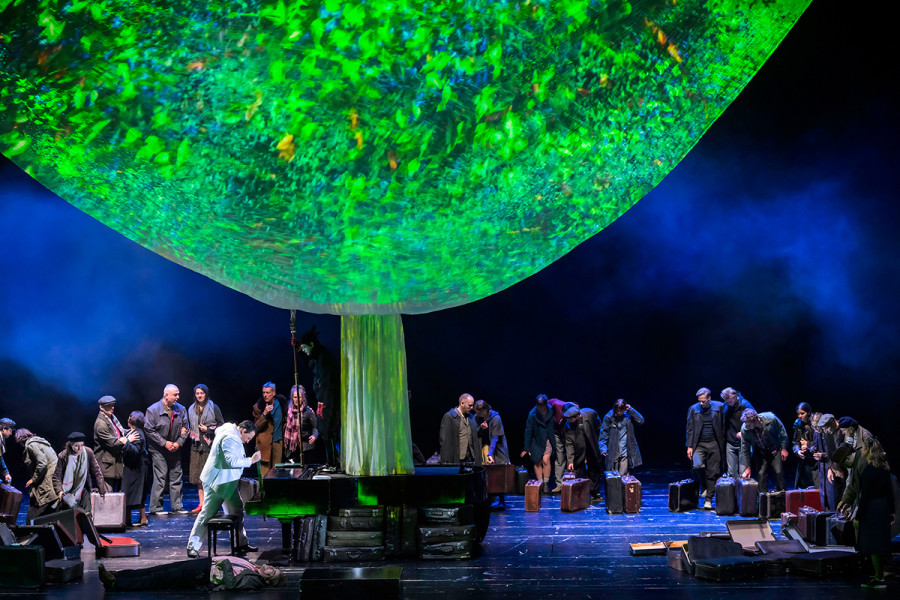
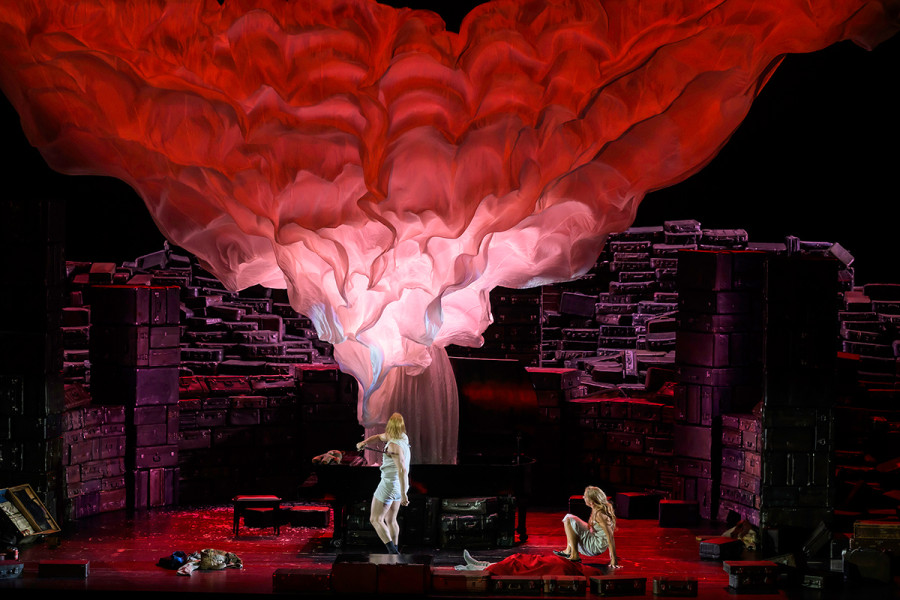
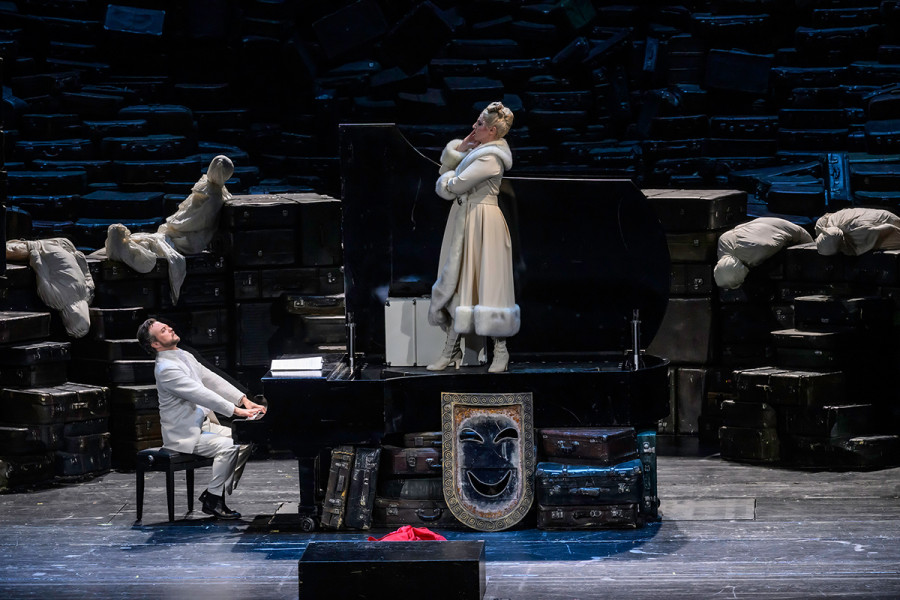
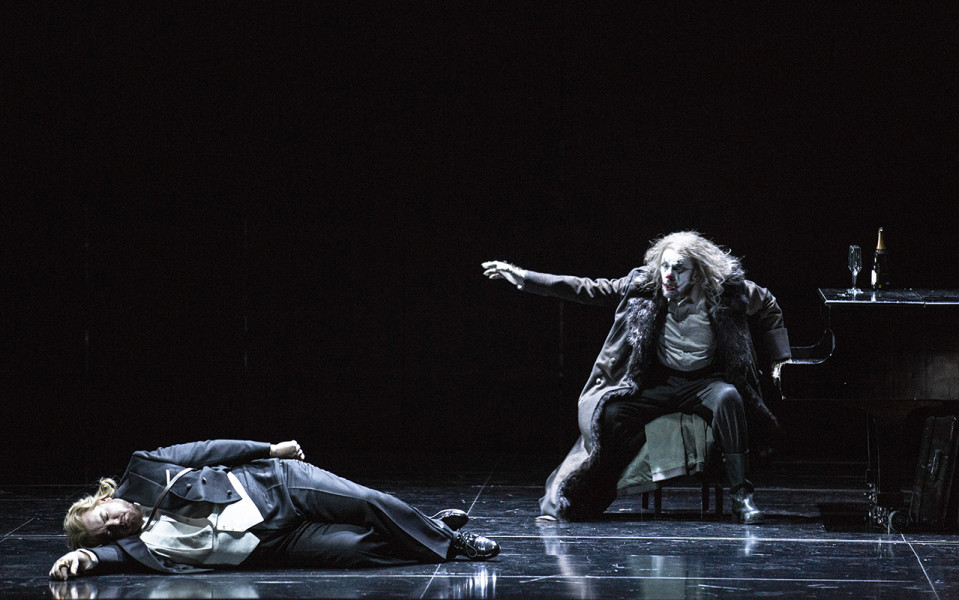
Right from the start, it is clear that Herheim, working alongside stage designer Silke Bauer, aims for a completely unique angle on the drama. Walking into the theatre, during the first evening, you are met with a huge, empty stage. The only object is a grand piano on the right side; its lid draped in a red cloth. This piano never leaves the stage; it stands as a physical manifestation of the composer’s mind throughout all four operas. Main characters play on it, and they frequently use its open case like a portal to enter and exit the scene.
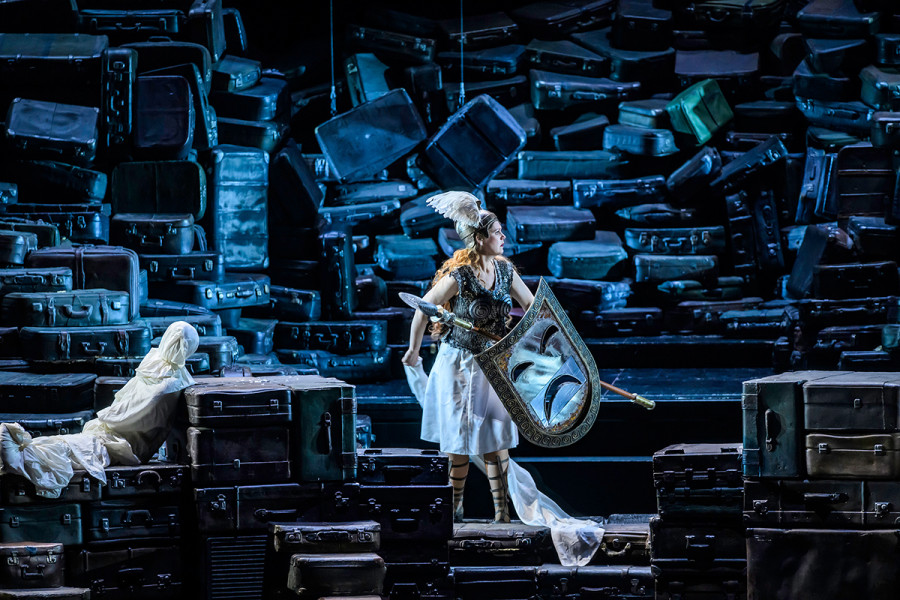
Old-fashioned suitcases form the backbone of the scenery. They are piled everywhere, stacking up to build caves, towering walls, craggy rocks, and homes. The singers have to scramble across these uneven surfaces constantly—a massive physical challenge in itself. Conceptually, these suitcases represent travel and constant transition. Alongside them, a massive white sheet gets constant use, morphing to fit the drama by turning into waves, clouds, or raging flames. At key moments, video designs by Torge Møller project leaves or fire directly onto the fabric. The lighting by Ulrich Niepel does heavy narrative lifting too, shifting between stark brightness and low shadows to track the psychological shifts of the characters.
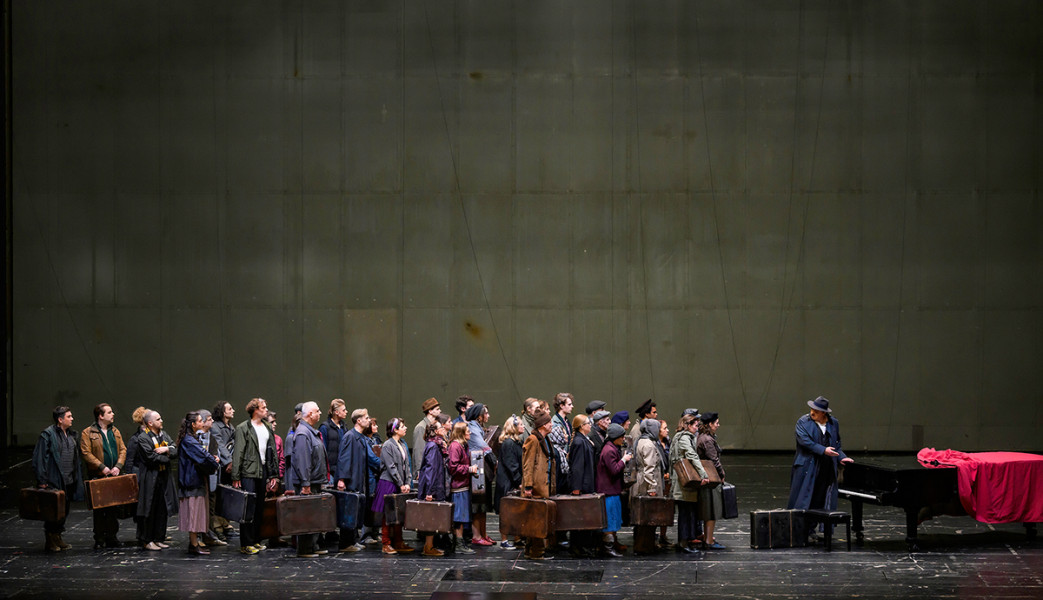
In Das Rheingold, the journey starts with a large group of travellers hauling these suitcases slowly across the stage. Their leader, Wotan, places his hand on the piano. The mysterious and magical sustained low E-flat played by the double basses and contrabassoon, which takes us into the depths of the Rhine begins, and the wheels are officially set in motion.
This silent crowd hovers over the entire tetralogy, closely observing the narrative while moving parallel to the main plot. They evoke the image of refugees—vulnerable, displaced, and trapped by fate. Throughout the cycle, they are seen embracing and engaging in carnal encounters, eventually dressing as the gods themselves by the time we reach Götterdämmerung. Functioning as a silent chorus reminiscent of ancient Greek drama, they frame the epic with their collective gaze.
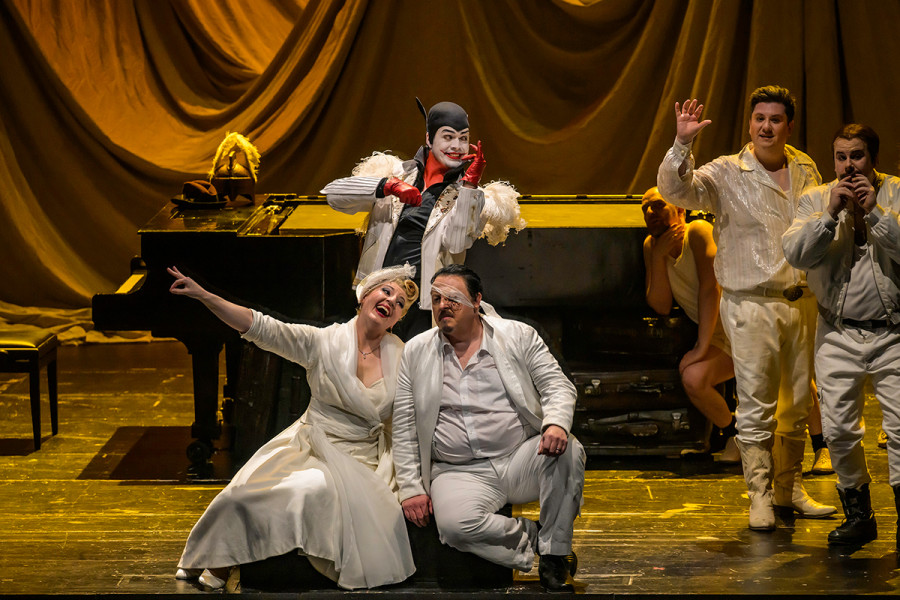
Herheim drops a major conceptual marker in the final act of Götterdämmerung by revealing the actual foyer of the Deutsche Oper on stage. It is a brilliant, telling choice that signals to the audience that this story is happening right here, right now, among us.
One could spend hours breaking down Herheim‘s endless stream of ideas and inventive staging in every single act. Ultimately, he pulls the plot and its deep symbolism right into the modern era. He balances the timeless truths of Wagner’s text with an intimate understanding of the score, a sharp sense of humour—especially during the gods’ meeting in Das Rheingold—theatrical wit, and a clear, profound mindfulness for the masterpiece. In a nutshell, visually and conceptually, his stage direction, alongside his brilliant creative team, felt exciting, thought-provoking, and amusing.
Yet above all, the musical execution itself proved to be the crowning glory—from the singers and the orchestra to the chorus in Götterdämmerung, guided by the seasoned conductor Sir Donald Runnicles.
This stood as one of those rare instances in a production of such vast scale where there was absolutely no weakness in the cast or any subpar performances. The astonishing singers lived up to every expectation and demonstrated a mastery of authentic Wagnerian style.
A number of the artists tackled more than one role. Furthermore, the production offered no less than three different singers for the role of Brünnhilde and two for the role of Wotan.
In Das Rheingold the three Rhine maidens were gracefully and fluently sung by Lea-ann Dunbar (Woglinde), Arianna Manganello (Wellgunde) and Karis Tucker (Flosshilde).
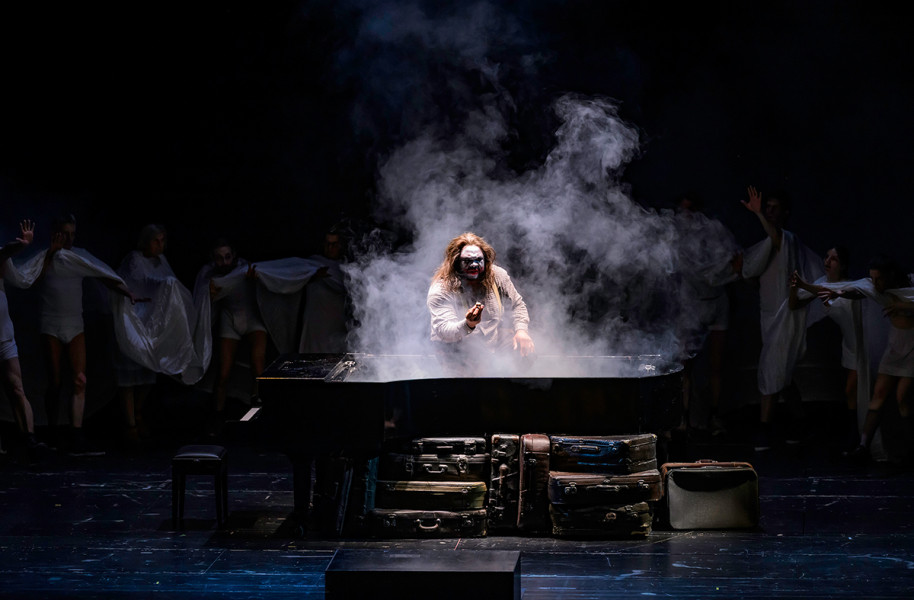
Michael Sumuel gave a thrilling vocal and theatrical performance as Alberich, a character who, in this production, assumed the distinct aesthetic and manic energy of DC Comics’ Joker. His secure, firm, resonant bass-baritone voice merged seamlessly with his dynamic stage movement, ensuring that Alberich’s unbridled greed emerged with unsettling clarity. Beyond his physical commitment, his exceptional vocal acting was highly noteworthy. He proved to be the ideal vehicle for Herheim’s quasi-provocative concept, masterfully capturing the Joker’s sarcastic manner. This was particularly evident during the transformation scene in Das Rheingold. When challenged by the manipulative Loge to transform into a giant serpent, Alberich instead turned his back to the audience, opened his trousers, and exposed himself to Wotan and Loge. This striking gesture brilliantly underlined his complete contempt for them, reinforcing his belief that he had absolutely nothing to prove.
Iain Paterson’s Wotan—appearing in Das Rheingold and as Der Wanderer in Siegfried—skilfully projected the ruler’s authoritative wisdom, irony, and deeply troubled psyche. His noble baritone remains in good form, though at times his lowest register felt less grounded.
Annika Schlicht delivered a strong-willed, vocally intense Fricka—the goddess of marriage and wife of Wotan—in Das Rheingold and Die Walküre, while proving equally impressive as the Valkyrie Waltraute in Götterdämmerung. Every dramatic nuance of her roles was meticulously considered; she possesses a true powerhouse of a voice and commands absolute control over its formidable range. By tackling both roles in the same cycle, she keeps alive a historic tradition practiced by a number of illustrious past mezzos—such as Elisabeth Höngen, Blanche Thebom, and Christa Ludwig—who occasionally even combined these performances with the first or second Norn.
Thomas Lehman (Donner), Kieran Carrel (Froh) and Martina Welschenbach (Freia), at their absolute best, were excellently characterful as the other gods.
Thomas Blondelle’s incarnation of Loge—the demigod of fire and the intellectual mastermind of the opera—offered a masterclass in musical and theatrical interpretation. Through impeccable German diction, Blondelle brought out every nuance of the text, perfectly capturing the god’s cynical cunning. His precise phrasing and the impressive size of his heroic tenor voice place him in a rare lineage (after all, Heinrich Vogl, who created the role at the 1869 Munich premiere, was the foremost Heldentenor of his day). Near the end of Das Rheingold, the intellectual bite and dry wit with which he delivered cynical phrases such as, “Fast schäm’ ich mich, mit ihnen zu schaffen!”, were remarkable. Blondelle’s fine theatricality easily earns him a place alongside legendary Loges of the past like Gerhard Stolze and Heinz Zednik. Given his vocal trajectory, one wonders if we may look forward to hearing him more frequently in heavier Wagnerian roles: having already sung Siegfried and Parsifal, Tristan is surely waiting in the wings, though he is wise not to hurry for now.
In Das Rheingold, Albert Pesendorfer’s Fasolt and Tobias Kehrer’s Fafner offered a thunderous, brutal realization of the giants. Pesendorfer underlined the romantic vein of the character in the end, when he does not wish to part from Freia, with whom he is infatuated.
Kehrer proved equally compelling when reprising the role of Fafner in Siegfried, where the profound moment of the dying dragon reverting to his primordial giant form to warn the titular hero of the Ring’s curse was rendered with striking pathos. He was also a high-calibre, ominous Hunding in Die Walküre.
In Götterdämmerung, Pesendorfer delivered a frightening and menacing portrayal of Hagen, characterized by an imposing voice quality, dark timbre, and an exemplary synthesis of textual and musical detail. As he is currently a professor of voice at the Berlin University of the Arts (Universität der Künste Berlin), his students are undoubtedly fortunate to learn from an artist of such unrivalled expertise and dramatic acumen.
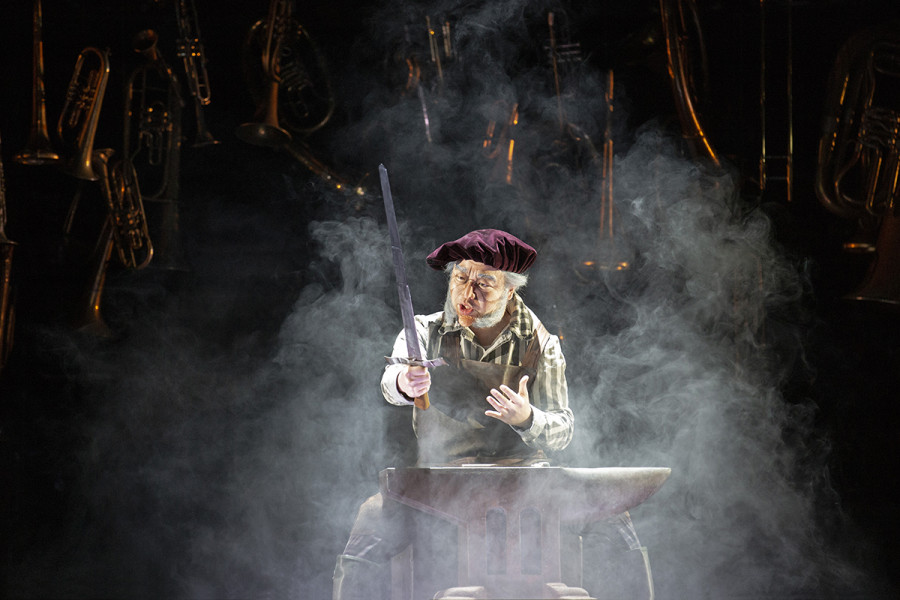
Ya-Chung Huang was a scintillating Mime in Das Rheingold and Siegfried. He has sung the part on a number of occasions, notably at the Bayreuth Festival in 2024 and 2025, and prior to that here at the Deutsche Oper Berlin—including his June 2021 role debut in Das Rheingold, his Siegfried role debut in November 2021, and both roles in the full Ring cycles of May and June 2024. His extensive experience has borne perfection. Musically, and through both voice and movement, he brought a brilliant theatricality to this sleazy and devious figure, projecting at times a funny characterisation that added great nuance to the evening.
Lauren Decker’s rare, exceptionally deep, and lush contralto voice proved ideal for the taxing role of Erda. The artist was absolutely marvelous in Das Rheingold and Siegfried. Her prophetic warning, “Weiche, Wotan, weiche!”, in the first opera was something to be remembered. She also adeptly took up the roles of Schwertleite in Die Walküre and the First Norn in Götterdämmerung.
In Die Walküre, Wotan was portrayed by Jordan Shanahan with remarkable authority and vocal charisma. The Hawaiian baritone made the most of the major confrontation scene with his favourite daughter, Brünnhilde, in Act III, showing deep dramatic involvement in the monumental and profound final farewell scene, which begins with the heart-wrenching words, “Leb wohl, du kühnes, herrliches Kind!”
Trine Møller was the Brünnhilde in Die Walküre, combining heroic singing with a fabulous lyrical expression when needed. She definitely brought deep emotion to this beloved heroine.
Her eight sisters were performed by Martina Welschenbach (Helmwige), Felicia Moore (Gerhilde), Maria Motolygina (Ortlinde), Aleksandra Meteleva (Waltraute), Arianna Manganello (Siegrune), Karis Tucker (Roßweiße), Nicole Piccolomini (Grimgerde), and Lauren Decker (Schwertleite). They all showed a great sense of ensemble while displaying their individual special vocal capacities, proving splendid during the famous Act III beginning ride of the Valkyries.
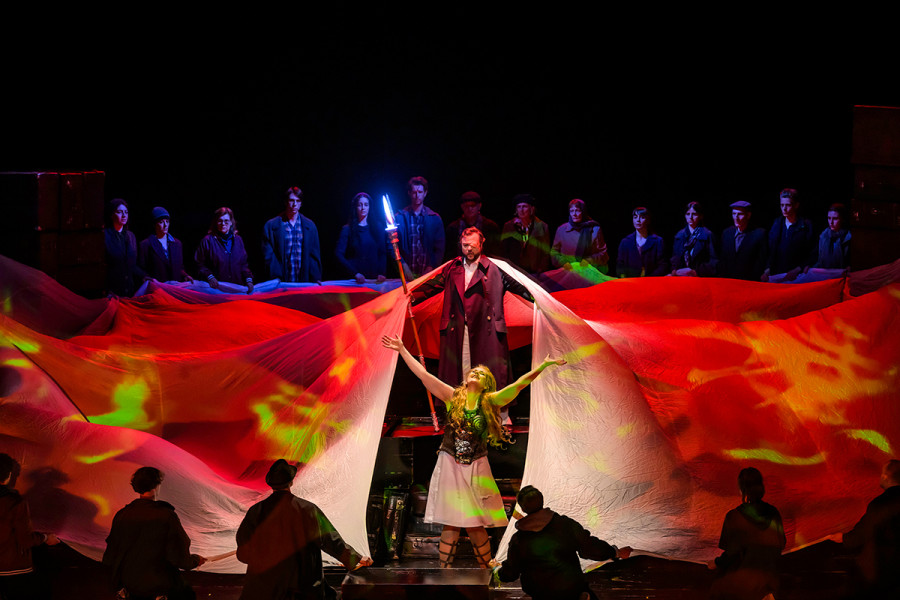
In this same opera, Matthew Newlin and Elisabeth Teige formed a youthful and poignant amorous couple as Siegmund and Sieglinde, singing with sonorous and well-projected voices. The famous Act I love duet, “Winterstürme wichen dem Wonnemond,“ was ravishingly rendered. During Act I, Herheim added an extra character: the young, deformed Hundingling (Eric Naumann), son of Hunding and Sieglinde. He is present during most of the act, and his mother kills him at the end of the opera.
Teige also portrayed Brünnhilde in Siegfried, finding abundant room to delve deeply into the heroine’s anxieties and ambivalence during the final stages of the opera, which she delivered with astonishing precision and truth.
In Siegfried, for the part of the Woodbird, Stefan Herheim departs from the traditional high soprano in favour of a boy’s voice. This choice revives Wagner’s original intention for the role, which he only altered for practical performance considerations. Here, the avian warnings were affectingly sung and acted on stage by Cornelius Park, a young soloist from the Knabenchor der Chorakademie Dortmund. During the atmospheric forest scene, Herheim visualizes the Woodbird as a blindfolded oracle. As this spectral guide delivers its warnings, the staging conjures a manifestation of Siegfried’s subconscious, bringing his deceased parents physically back to the stage as silent memories.
In the last part of the Ring, Götterdämmerung, during the Prologue (Vorspiel), the three Norns—daughters of Erda and goddesses of fate and destiny, representing the distant past, the present, and the future—were sung by Lauren Decker (First Norn), Karis Tucker (Second Norn), and Felicia Moore (Third Norn). They formed a finely balanced trio, bringing off their narrations, fears, and predictions for the future with full voices and intellectual gravitas.
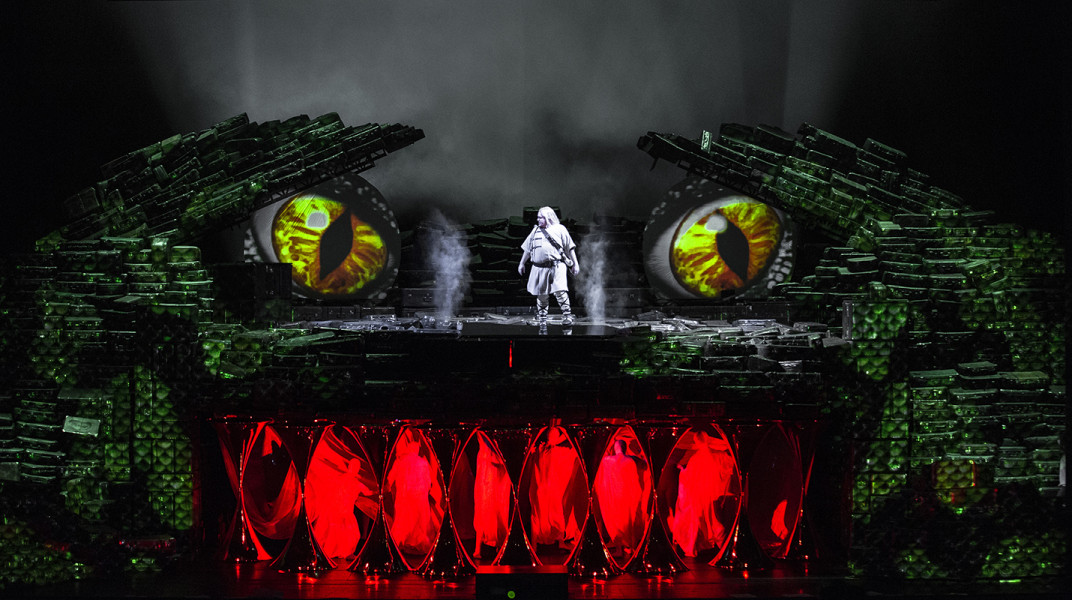
Clay Hilley’s portrayal of Siegfried was a showstopper. He led the drama with a robust, resplendent, and fearless voice, delivering a nuanced performance that blended humour, heroism, and tragedy. His shocked realization upon uncovering Brünnhilde, expressed through “Das ist kein Mann!”, provided a notable, endearing moment of comic timing, sparking an amused giggle from the audience.
In the roles of the two siblings of the Gibichung clan, Gunther and Gudrune, Thomas Lehman and Felicia Moore offered finely sung and acted performances. They subtly complemented the sinister side of Hagen, portrayed by Albert Pesendorfer. Together, this trio brilliantly managed the psychological deception of the plot, administering a magic draught that erased Siegfried’s memory and forced him to forget his beloved Brünnhilde.
Catherine Foster, undoubtedly one of the great Brünnhildes of our time, whom I had admired as the Die Walküre Brünnhilde in Athens during the premiere of the Greek National Opera’s production on March 10, 2024, gave a noble, immaculate vocal and dramatic performance. Following a glorious tradition of great British Wagnerian singers who sang the role—Dame Gwyneth Jones, Rita Hunter, and Dame Anne Evans easily spring to mind—she blended compassion, strength of character, and enthusiasm. Her marvelously resilient and well-crafted instrument served her from her opening bars to the final immolation, which she performed in a transcendent and cathartic manner. Especially in Götterdämmerung, she and Clay Hilley proved heroic and moving, fully vanquishing the Herculean challenges of their roles.
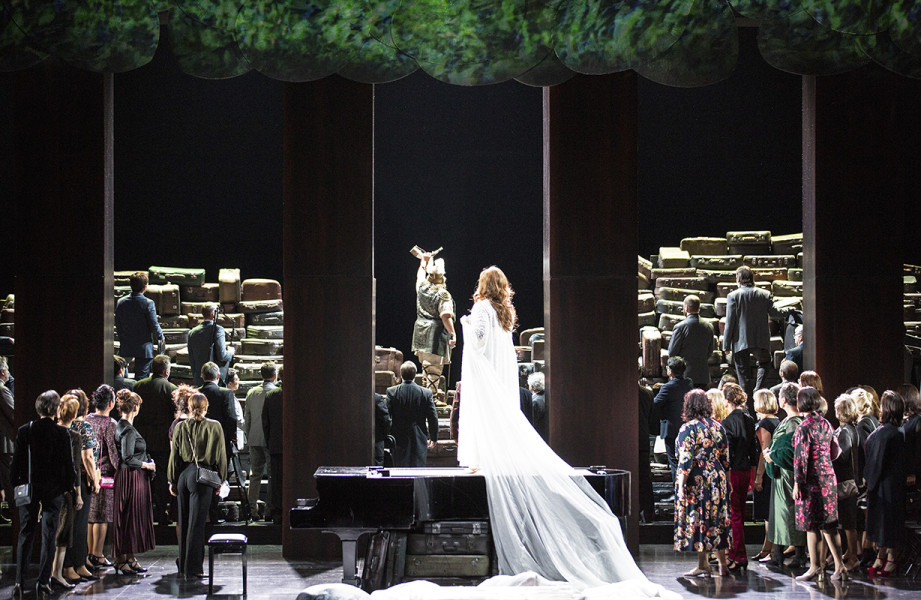
The male chorus in Act II, Scene 3, answering Hagen’s call to arms—“Hoiho! Hoihohoho! Ihr Gibichsmannen, machet euch auf!“ —arrived on stage directly from the auditorium and sang its heart out. The thunderous sound of the choir, prepared by Belfast-born chorus master Jeremy Bines, was imposing and electrifying. The brief contribution of the female section was equally pleasing; it is worth noting that the women of the chorus sing for a mere sixteen bars during their fleeting appearance in Act II, welcoming Gunther and Brünnhilde with the lines, “ Heil dir, Gunther! Heil dir, deiner Braut! Grüß’ ich die Beglückte!“. Furthermore, during the Act III, Scene 2 hunting scene, the male chorus was magnificent, radiating tragic theatrical power as Siegfried’s companions. They beautifully executed the ensemble lines alongside him during his lengthy narrative and reacted with utter astonishment when Hagen stabbed him in the back (“Hagen, was tust du? Was tatest du?”).
The Rhine maidens in Götterdämmerung—Nina Solodovnikova (Woglinde), Karis Tucker (Wellgunde), and Stephanie Wake-Edwards (Flosshilde)—were calliphonous and seductive while trying in vain to recover the Ring from Siegfried, warning him of his impending doom. When they realize in anguish that they cannot succeed, Herheim has them dive beneath the white sheet and emerge as eerie, bald women.
The orchestra, under the masterful baton of Sir Donald Runnicles—who remained closely faithful to the score’s indications—frequently stole the show with a captivating performance, executing the piece with dedication, eloquence, verve, and dramatic zest, as if it had been composed expressly for them. They produced insightful readings wrapped in noble grandeur and a majestic acoustic profile, meticulously honouring the specific character of each section while illuminating thousands of orchestral details, subtle shadings, and dynamic nuances. The strings phrased with soul-stirring emotional depth, while the woodwinds and brass consistently sounded clear, full, and tonally impeccable.
Having performed the cycle together on numerous occasions, both the musicians and Sir Donald exuded deep expertise in every bar of the music. Tempi were always perfectly balanced, and the orchestral textures never overwhelmed the singers, who overtly relished the collaboration.
After each performance, the audience showed its appreciation with enthusiastic applause and a vociferous reception that was fully deserved, speaking volumes about the quality and success of the production.
The ultimate curtain call at the conclusion of the cycle marked a profoundly emotional milestone for Runnicles and the assembly, coinciding with the official termination of his tenure as General Music Director. Conducting Richard Wagner’s Götterdämmerung to culminate his seventeen-season legacy engendered a profound, palpable wave of sentiment that suffused both the stage and the auditorium.
