

When discussing Richard Strauss’s Elektra, Op. 58—first performed in Dresden in January 1909—it is frequently overlooked that the once-celebrated, though now largely forgotten, conductor Ernst von Schuch was instrumental in executing this complex score, much as he had been at the premiere of the composer’s preceding opera, Salome, Op. 54. Schuch was the driving force behind Strauss’s early operatic triumphs, establishing the Dresden Court Opera as his principal creative workshop. From its podium, the conductor fearlessly championed Strauss’s boldest modernist scores, directing the world premieres of Feuersnot (1901), Salome (1905), Elektra (1909), and Der Rosenkavalier (1911). Possessing a rare gift for balancing dense orchestral textures with theatrical clarity, he earned the composer’s lifelong gratitude as the ideal interpreter of his dramatic vision. It is equally worth noting that Schuch maintained a warm, decades-long friendship with fellow Austrian Gustav Mahler, having first met the young composer in 1884. As General Music Director, Schuch became one of Mahler’s fiercest advocates in Germany, introducing his monumental and often controversial symphonies to local audiences long before they achieved widespread acclaim. His artistic legacy continued into the next generation through his daughters, most notably Liesel von Schuch, who earned renown as a leading coloratura soprano and longtime vocal pedagogue in the Saxon capital.
The Deutsche Oper Berlin recently revived Kirsten Harms’s staging of Elektra, which originally premiered on this stage nineteen years ago, on 3 November 2007. Having attended the opening night of the current revival on 6 November, I was thoroughly impressed by the production and, above all, by its musical execution.
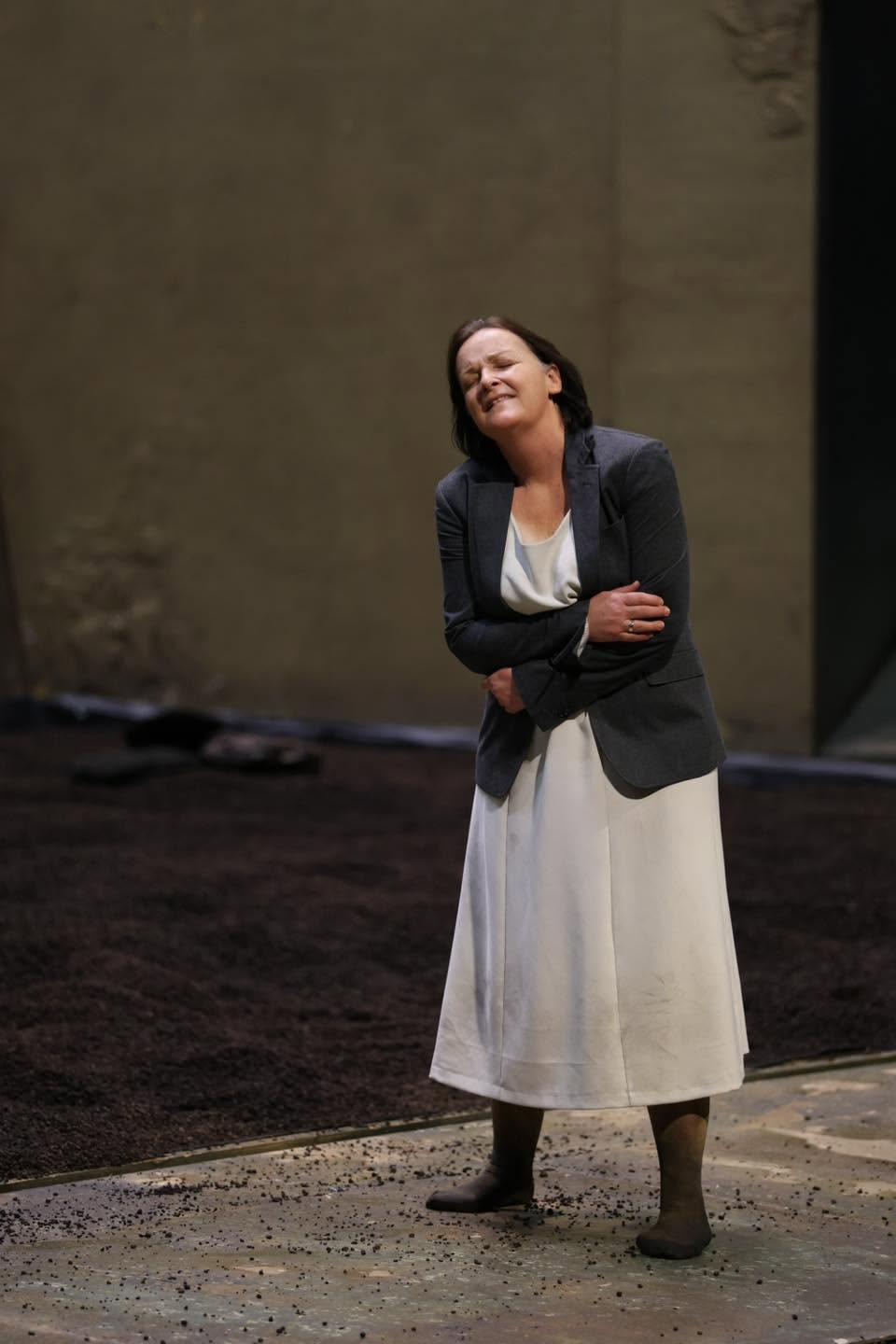
Harms’s direction adheres closely to the familiar narrative of Sophocles’ tragedy, as adapted by the composer’s close collaborator, Hugo von Hofmannsthal. Consumed by grief and hatred following the murder of her father by her mother and stepfather, Princess Elektra relentlessly plots their demise until her long-lost brother, Orestes, returns to exact bloody retribution, leaving her to collapse lifelessly in an ecstatic dance. The director encourages her singers to project their innermost thoughts while moving across a bare earth floor. In this staging, the action unfolds within imposing, towering walls—broken only by a single window and door on either side, which opened solely to admit the cast—designed by Bernd Damovsky, whose severe architecture heightens the oppressive psychological claustrophobia experienced by the protagonist. The costumes, likewise conceived by Damovsky, possess a timeless quality that remains faithful to the archetypal nature of the characters. Klytämnestra’s attire was particularly opulent; dressed in crimson and black, she wore a bright white wig and long strands of white pearls.
Ricarda Merbeth delivered an extraordinary account of the title part, an assignment of which she holds indisputable command. Having previously sung Chrysothemis, she first assumed Elektra at Teatro alla Scala in November 2018—in a revival of Patrice Chéreau’s final operatic staging—and has since reprised the part across numerous international houses. What distinguishes her interpretation is her complete mastery of its formidable demands: a prodigious voice, immaculate technique, and a keen grasp of the character’s psychological complexity. Her portrayal was resolute and consumed by an obsession with vengeance. Her opening monologue (“Allein! Weh, ganz allein”) was rendered with remarkable nobility and heroic stature, and she infused individual words with profound dramatic weight—most notably her pointed inflection of “Mutter” in “Tochter meiner Mutter, Tochter Klytämnestras” during the confrontation with her sister. Her forthcoming appearances in Stéphane Braunschweig’s staging for the Teatro del Maggio Musicale Fiorentino promise to be equally absorbing.
Deputising at short notice for Ann-Kathrin Niemczyk, Flurina Stucki offered a persuasive reading of Chrysothemis. Drawing upon her years as an ensemble member at the Deutsche Oper Berlin and her prior appearances in Harms’s production—including under Juraj Valčuha’s baton in 2022—she commanded the austere setting with assured theatrical instinct and vocal composure. She conveyed with great sensitivity the vulnerability of a sister torn between familial loyalty and horror at Elektra’s fixation on matricide and revenge. Vocally, Stucki combines an immediately recognisable, silvery timbre with a gleaming upper register and natural stage presence. While her jugendlich-dramatisch instrument points convincingly towards a future Elektra, she need not rush towards Strauss’s most punishing heroine while so much rewarding intermediate repertoire—such as Ludwig van Beethoven’s Leonore or Richard Wagner’s Elsa—remains to be explored.
Okka von der Damerau, whose opulent voice is a marvel, offered an exemplary portrayal of Klytämnestra—detailed and fraught with terror and torment, yet never forfeiting the character’s regal bearing. Tobias Kehrer’s plangent, dark bass-baritone lent exceptional gravitas and authority to Orest, while Michael J. Scott was persuasive in his brief appearance as the alarmed Aegisth. The Maids were sung and acted with distinction by Kai Rüütel-Pajula, Marlen Bieber, Lauryn Davis, Julieth Lozano, and Martina Russomanno—with Russomanno, as the Fifth Maid expressing her devotion to Elektra, emerging as a young voice of notable promise. The cast was ably completed by Olymar Salinas (Young Servant), Michael Bachtadze (Old Servant), and Barbara Dobrzanska (Overseer).
In the pit, the musical direction under Valčuha stood out. His reading was taut, incisive, and full of impetus. Leading the superb Orchestra of the Deutsche Oper Berlin, Valčuha clearly uncovered the intricate details of Strauss’s dense score while bringing the blood-soaked drama of this masterwork vividly to the surface.
