

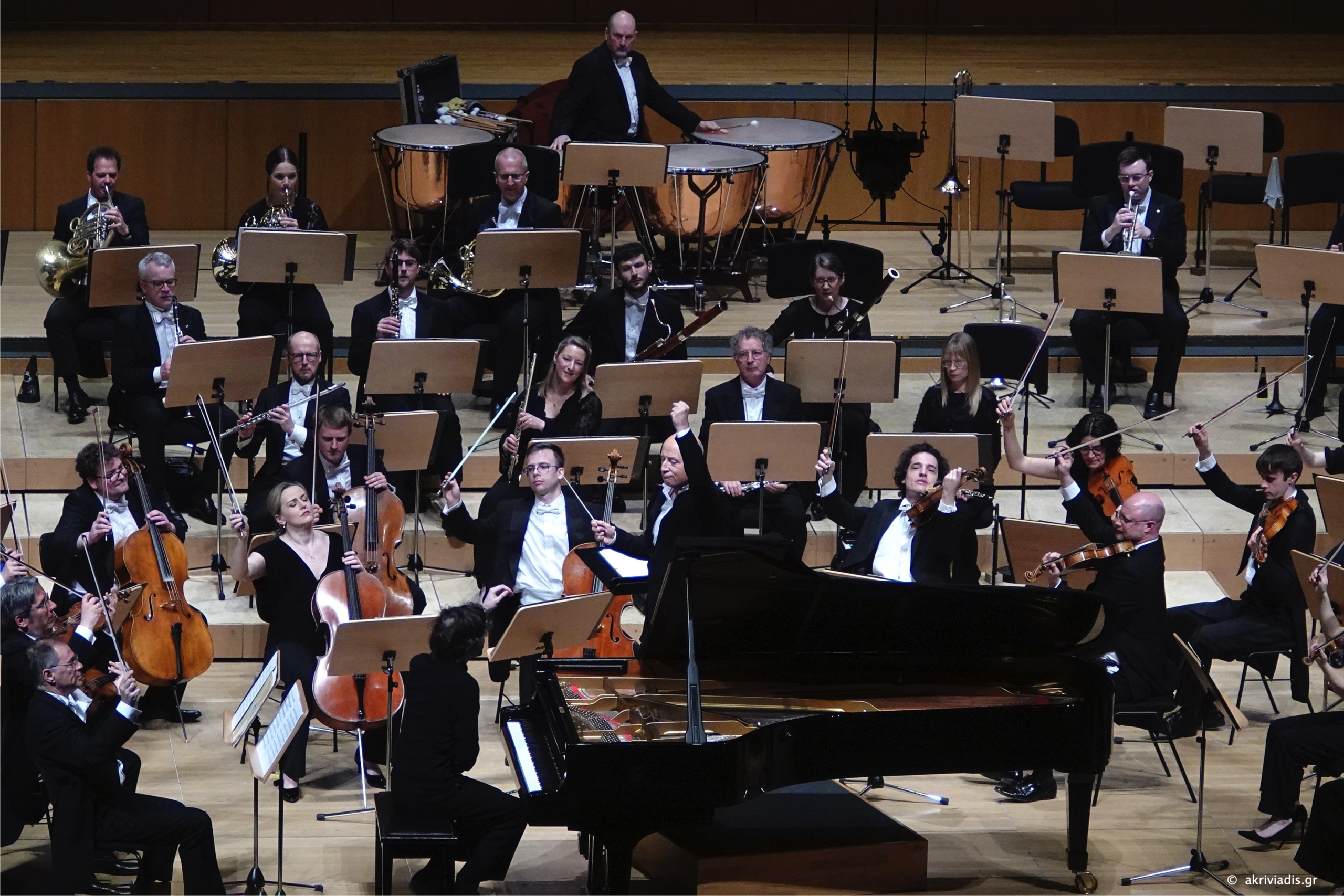
On March 3, just a few days before the London Philharmonic Orchestra’s Athens concert under the baton of Paavo Järvi, given on March 7 at the Athens Concert Hall (Christos Lambrakis Hall), it was announced that the conductor will assume the position of Chief Conductor and Artistic Advisor of the orchestra beginning in the 2028–2029 season, with an initial five-year contract.
Järvi will succeed his (equally) busy British colleague, Edward Gardner, who enjoyed a widely acknowledged successful tenure in this position, albeit for a relatively short period of time (i.e. from 2021; however, it should be noted that he first conducted the orchestra way back in 2003), a fact confirmed both by the quality of his concerts and by his recordings.
The special bond that has developed between Järvi and the renowned orchestra (founded in 1932 by the legendary British conductors Sir Thomas Beecham, 1879–1961, and Sir Malcolm Sargent, 1895–1967), was fully evident during the recent concert.
The first part of the evening featured Piano Concerto No. 2, Op. 44, by Pyotr Ilyich Tchaikovsky (1840–1893), completed in 1880; although definitely a masterpiece, full of beautifully shaped melodies and exciting virtuosic passages, unfortunately it is rarely heard, in contrast to the same composer’s Concerto No. 1, Op. 23, which is among the public’s favourites and is frequently performed.
The solo part was delivered by brilliant French young pianist Alexandre Kantorow, who gained world fame in triumphing at the 2019 International Tchaikovsky Competition. The gold medal he won was due not only to his distinctive and promising musical personality, but also to his impressive interpretation of this same work.
He has performed the Concerto in various parts of the world, always to great acclaim. His performance in Athens was no exception. The explosive energy of his playing, always steeped in a robust romanticism, was enough on its own to take the audience’s breath away and capture their hearts. But it was not just the energy and technical skill of his playing, which, it should be noted, never came to the fore in a sterile way, but rather his spontaneous, natural, and deeply personal sensitivity, which set him apart and elevated him to another level of expression and musicality.
In particular, the artist’s resonant chords and rich octaves, the refined execution of the arpeggios and of the restless syncopations of the first movement, Allegro brillante e molto vivace, which he performed with impeccable rhythmic precision, the moving lyricism of his playing, and the meticulous control of dynamics during the extended dialogues with the violin and cello in the second movement, Andante non troppo, as well as the fiery passion of his expression and his sparkling touch during the final movement, Allegro con fuoco, were among the captivating qualities of his performance.
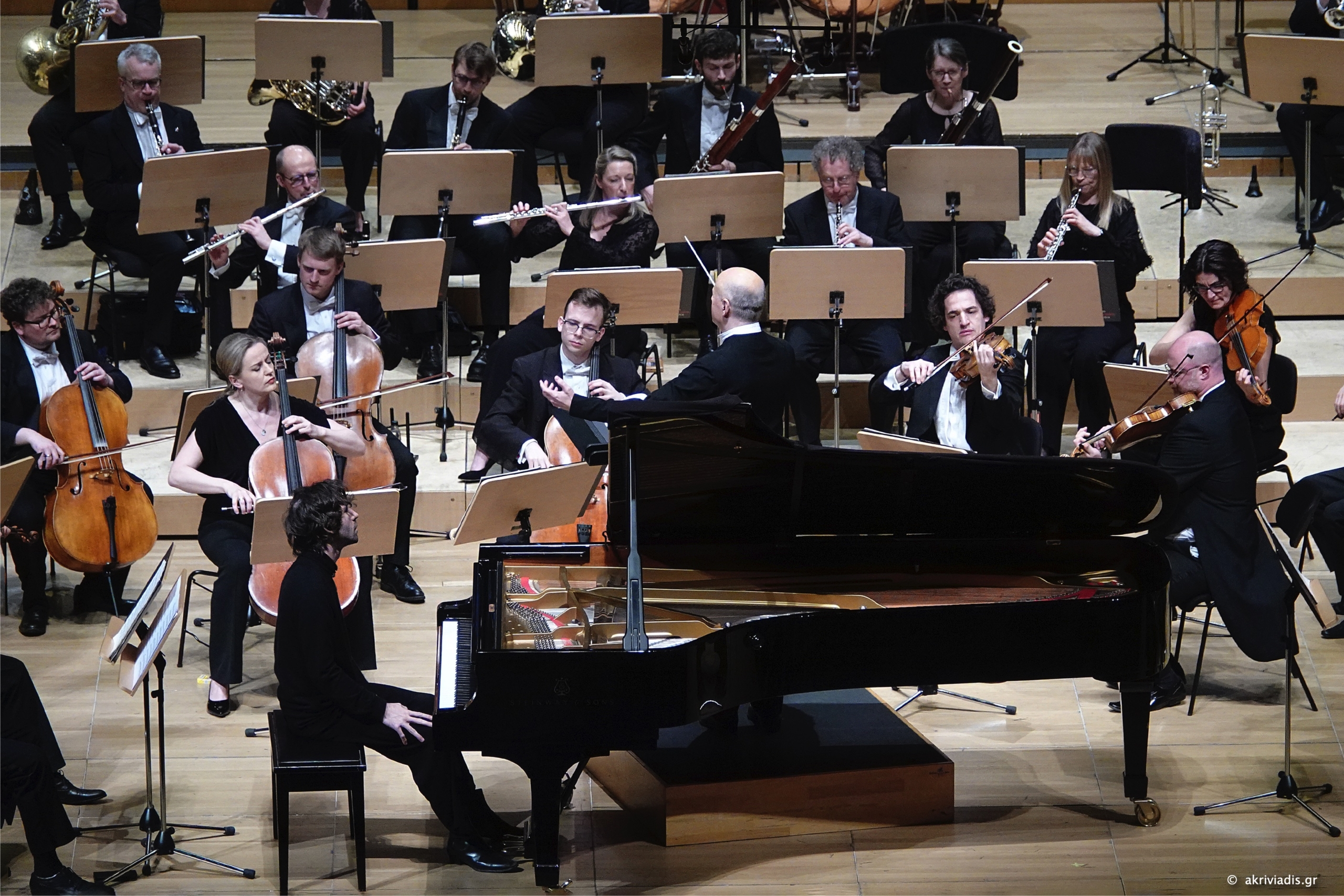
The London Philharmonic Orchestra and Järvi accompanied him with obvious respect and admiration. They supported him exquisitely at every moment on this thrilling journey. In particular, the rich sound of the strings, the contributions of the solo violin and solo cello, coloured with great sensitivity during the extensive solo passages of the second movement mentioned above—where the Concerto essentially transforms into a deeply introspective Triple Concerto— and the remarkable contributions of the flute, oboe, and clarinet, as well as those of the brass section, decisively contributed to the high quality of the performance.
It should be added that Kantorow has not yet officially recorded the work, so one hopes that a new album capturing his fascinating reading will arrive soon.
As an encore, the young star offered a deeply poetic and inspired interpretation of Richard Wagner’s (1813–1883) Isoldens Liebestod, in the famous transcription by Franz Liszt (1811–1886). Under his fingers, the contrapuntal melodic lines, the intensely sensual chromatic harmony, and the virtuosic octaves emerged with imaginative artistry, culminating in a fading of sublime exaltation, morendo, and pianissimi, pianississimi broken chords.
The rare virtues of the London Philharmonic Orchestra were also admired during the second part of the evening featuring an equally outstanding performance of Symphony No. 2, Op. 43, by Jean Sibelius (1865–1957), completed in 1902 and successfully premiered that same year in Helsinki. It was deemed an apt choice to perform it following Tchaikovsky’s concerto, as Sibelius admired the leading Russian composer and was influenced by him, particularly during the time he wrote his first two symphonies.
Järvi and the orchestra skilfully highlighted the long melodies (which in some ways resemble those of Tchaikovsky’s, at least as far as their formation is concerned), while at the same time bringing to the fore the distinctive, deeply personal harmonic language and structural integrity of Sibelius’s score. The thematic developments, as well as the finely balanced orchestration, were presented in an exemplary manner. The Finale, Allegro moderato, which contains one of the most famous themes in classical music literature, brimming with patriotic sentiment, was delivered with the appropriate grandeur. The conductor’s precise, always clear, and well-controlled gestures—he generally refrains from exaggerated movements and expressions, which might easily win over a large portion of the audience for the wrong reasons— inspired the orchestra and contributed to the substantial and engaging rendering offered.
