

January and February found Berlin in snow and ice. However, music lovers living in this magnificent city, as well as music lovers visiting it, always have the opportunity to find warmth and comfort in one of its wonderful concert halls or opera houses. Berlin’s musical life is definitely one of the richest in the world, both in terms of quality and quantity.
During our most recent visit to Berlin, we had the opportunity to attend a series of opera performances.
The Flying Dutchman
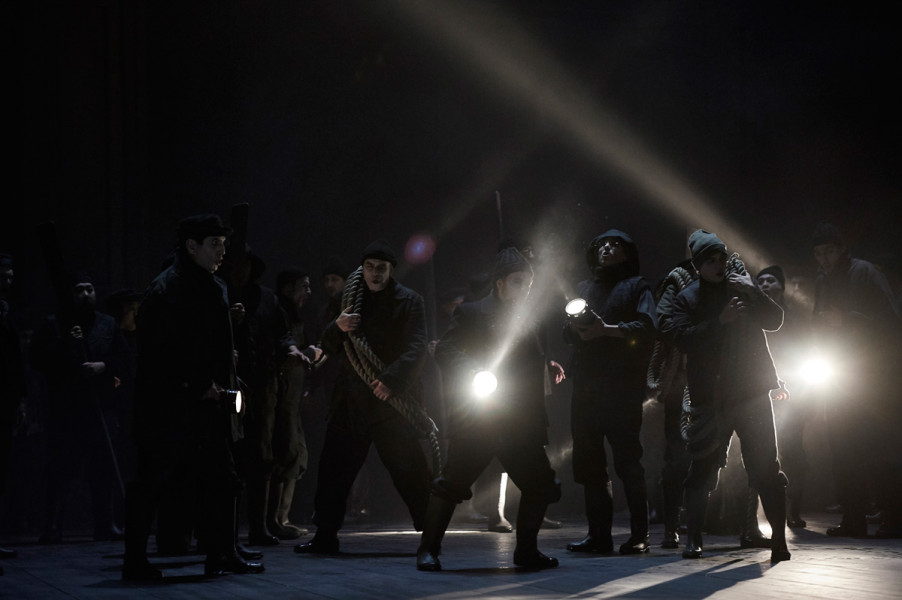
On January 28, at the German Opera in Berlin (Deutsche Oper Berlin), we saw and heard Richard Wagner’s opera Der fliegende Holländer (The Flying Dutchman), premiered in Dresden on January 2, 1843, being the first of the composer’s mature stage works. The recent performance was a revival of a production signed by director and choreographer Christian Spuck, artistic director of the Berlin State Ballet since 2023; the production was premiered on May 7, 2017. Spuck’s ideas and narrative, brilliantly supported by Rufus Didwiszus (set design), Emma Ryott (costumes), and Ulrich Niepel (lighting), moved through darkness, the dream world, and anxiety. Furthermore, the visual aspect, the minimalist set and the dark-coloured and straightforwardly designed costumes inspired the singers to enter the appropriate dreamlike atmosphere of the work. Throughout the performance, water could be heard and seen dripping on stage, which brought the audience closer to the plot. At the opera’s very beginning, Spuck had the hunter Erik, sitting silently on the ground, at the left of the stage. The hero is engaged and in love with Senta, while she vividly dreams of the arrival of the mysterious Dutchman and is indifferent to Erik. According to Spuck’s view, the story unfolded through Erik’s eyes, who in this production took center stage in the plot.
James Rutherford portrayed a Dutchman who was dark, tormented, and dreaming for redemption. His beautiful dark voice and clear diction stood out. During the opening monologue, Die Frist ist um (act I, scene II), he meaningfully emphasized his character’s sadness and pessimism.
Flurina Stucki performed Senta, the role of the innocent girl who is willing to save the Dutchman, with care and feeling. Before the performance began, it was announced to the audience that the artist was recovering from a cold and that although she had canceled her appearance in the previous performance, she wanted to take part in this one. There were very few moments of vocal strain, and we are absolutely grateful that she gave us the opportunity to appreciate her marvelous vocal and acting skills, through which she illuminated the faithful heroine. Furthermore, the famous ballad (Johohoe! Traft ihr das Schiff, heard during the second act, second scene), in which we learn the tragic story of the Dutchman cursed by Satan and the heroine’s conviction, or rather, obsession, to save him, was performed by her with emotion and passion.
The heroine’s father, Daland, was portrayed with conviction by Patrick Guetti, a member of the theater’s ensemble, who possesses an extra deep and resonant voice. He is a very tall man, who knows how to move on stage and act.
Kieran Carrel, also a member of the theater’s ensemble, as Erik, delighted with his steady vocal line and the freshness of his Mozartian lyrical voice. For the time being, I do hope that he will not move to heavier parts. In the comparatively smaller roles, Stephanie Wake-Edwards (Mary) and Andrei Danilov (helmsman) also made an excellent impression.
Conductor Sir Donald Runnicles, who will soon be ending his tenure as general music director of the Deutsche Oper Berlin (a position he has held since 2009), offered a flowing, fullhearted dramatic interpretation, displaying deep knowledge of the score. He managed to successfully highlight the qualities of each character and showcased the wonderful orchestration of the score. The performances of the orchestra and choir were exemplary, equally analytical and idiomatic.
Don Carlo
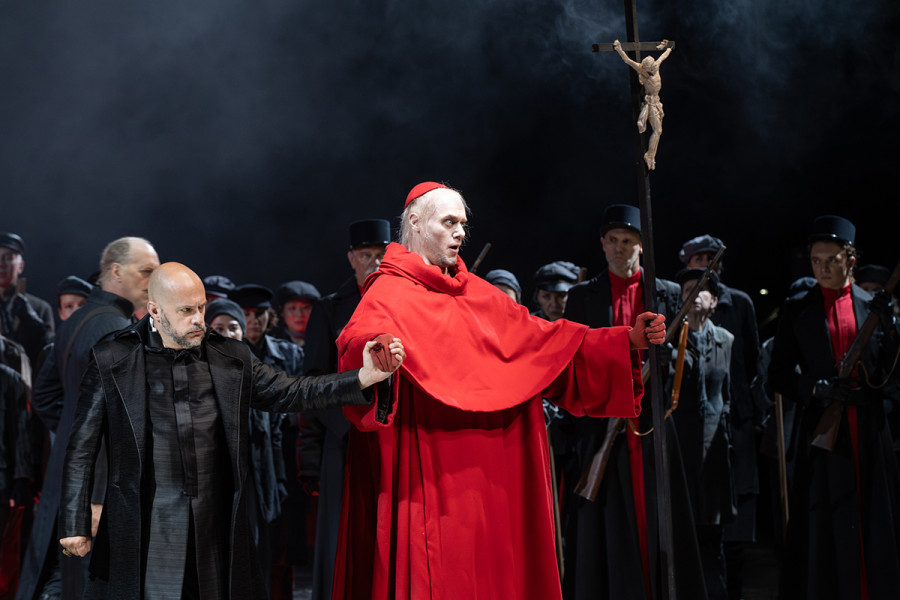
At the same opera house, a few days later, on January 31, I witnessed a production of Don Carlo, Giuseppe Verdi’s most grandiose and visionary masterpiece, directed, set designed, and lit by Marco Arturo Marelli. This was a revival of the production that was first seen on October 23, 2011. I found Marelli’s straightforward storytelling and minimalist set design consisting of large, wide, moving walls that occasionally formed the shape of a cross, highly interesting. Niefend’s lovely costumes were inspired by the historical period of the 16th century in which the plot of the play is set.
The singers formed an exceptional group, bringing forth the distinctive characteristics of their roles.
Thus, Don Carlo, son of King Philip, played by Valentyn Dytiuk, possessed the direct and spontaneous heroism that the role demands.
Christina Nilsson portrayed the tragic Elisabeth de Valois (who, although previously betrothed to Carlo, was subsequently married to King Philip) with elegance of expression, a strong middle voice and great ease in interpreting the high notes of the tessitura.
Karis Tucker wonderfully underlined the emotional fluctuations of the role of Eboli and performed the aria O don fatale (third act, thirteenth scene) with dramatic vigor.
As King Philip, Alexander Vinogradov succeeded in illuminating the psychological complexities, conflicts and anxieties of the role with his richly nuanced voice, for example in the aria Ella giammai m’amò, where his character accepts that his wife Elisabeth de Valois never loved him.
Geon Kim gave a convincing performance as Rodrigo, singing the aria Per me giunto è il dì supremo (Act III), undoubtedly containing some of Verdi’s most moving music, with idiomatic style and verve.
The Grand Inquisitor portrayed by Patrick Guetti, a bass whom I had recently appreciated at the same opera house as Daland (see above), was vocally and dramatically imposing. Both he and Vinogradov were impressive in the great pivotal scene of the third act, where the 90-year-old inquisitor confronts the King, who is considering killing his son who has turned against him.
The smaller roles were carefully performed by Kangyoon Shine Lee (Count of Lerma/Herald), Volodymyr Morozov (A Monk), Maria Vasilevskaya (Tebaldo), Sarah Vautour (A Voice), Morozov, Benjamin Dickerson, and Philipp Jekal (Envoys of Flanders).
Conductor Juraj Valčuha, with the excellent cast at his disposal, as well as the high-calibre orchestra and chorus, ensured a performance of passionate lyricism, highlighting the exquisite broad melodies and finely crafted orchestration of the score.
