
The influential Italian composer Luigi Cherubini stood as one of the luminaries of European music during his lifetime. A prolific creator, his output spanned landmark operas like Médée, Lodoïska, and Les deux journées, alongside profound choral works like his Requiems in C minor and D minor. Cherubini’s mastery commanded respect from his peers, earning the admiration of Ludwig van Beethoven, Felix Mendelssohn Bartholdy, Robert Schumann, and Johannes Brahms.
Beyond the stage, Cherubini shaped generations of musicians through his academic leadership. His Lessons on Counterpoint and Fugue, written during his tenure as Director of the Paris Conservatoire, remains a cornerstone of advanced music theory education today.
To the broader music-loving public, Cherubini is known today primarily through his opera Medea. It is historically noteworthy that the version most familiar to twentieth-century audiences is the product of a long and process of transformation, as the original French score with spoken dialogue vanished almost immediately after the Parisian premiere of 1797. The score was substantially altered in 1855, when Franz Lachner replaced the dialogues with his own orchestral recitatives, and was ultimately integrated into the Italian translation provided in 1909 by Carlo Zangarini.
In recent years, however, the opera has been staged with increasing frequency in its original form, offering audiences the opportunity to experience the masterpiece precisely as its creator conceived it. The return to the original French score of Médée reveals Cherubini’s unadulterated artistic vision, showcasing a wealth of musical inspiration, musicodramatic virtues, and pioneering dramatic innovations: from the emphasis on the psychological development of the roles and the extended musical scenes, to the ideal synthesis of Classicism with emerging Romanticism. A prime example is the final aria Du trouble affreux qui me dévore, which a frustrated Cherubini struck through with charcoal on the manuscript following the work’s lengthy premiere in 1797. Furthermore, the orchestra plays an active role, frequently providing commentary on the dramatic action rather than merely offering accompaniment. At the same time, the orchestration is tailored to each individual character, and the composer focuses on the deeper psychology of the protagonists—particularly Medea—employing innovative harmonic ideas, such as sudden and unexpected modulations. Additionally, the dialogues of the libretto, penned by François-Benoît Hoffmann, impart a distinct theatricality. This theatricality, combined with the preservation of a perfectly cohesive and homogeneous musical style, renders the study and hearing of the authentic version a revelatory experience.
By contrast, the aforementioned Italian version of the work—a historical alloy that fused the German musical intervention of Lachner (1855) with the subsequent translation of Zangarini (1909)—undoubtedly retains its own particular interest. This is due to its continuous and uninterrupted musical—though not stylistic—flow, which Callas uniquely championed from 1953 onwards.
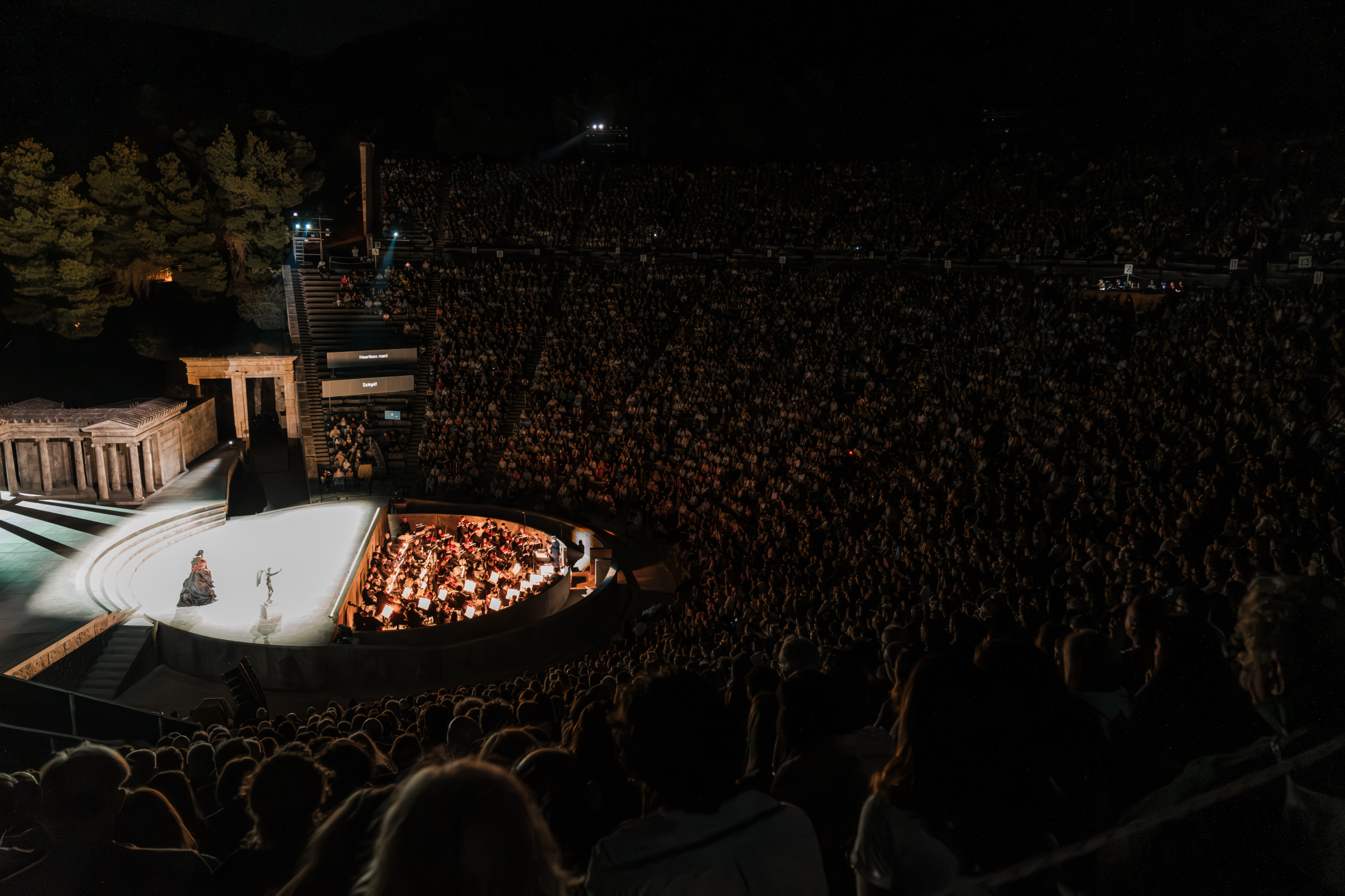
Recently, the Greek National Opera (GNO) presented a revival at the Ancient Theatre of Epidaurus of the legendary production of Medea in its Italian version—the very production performed by Maria Callas at the same venue on August 6 and 13, 1961, directed by Alexis Minotis, with sets and costumes by Yannis Tsarouchis, choreography by Maria Hors, and conducted by Nicola Rescigno. The vocal cast at the time was rounded out by combining prominent international opera singers with exceptionally talented Greek artists: Jon Vickers (Jason), Giuseppe Modesti (Creon), Soula Glantzi (Glauce), Kiki Morfoniou (Neris), Giorgos Zakkas (Leader of the Guard), Angeliki Drakopoulou (First Handmaiden), and Anna Maragaki (Second Handmaiden). It is worth noting that this was the final production in which Maria Callas collaborated with the GNO, and her penultimate appearance in Greece, with her last being in Lefkada in August 1964.
Today, none of the contributors to that historic production remain alive. It is particularly poignant that the beloved mezzo-soprano Kiki Morfoniou, who passed away on December 18, 2025, approximately six months before this revival, did not live to witness it or to pass down her experience to the younger generation of artists. Her contribution, both in terms of her interpretative legacy and her artistic experience, would have undoubtedly proven exceptionally precious.
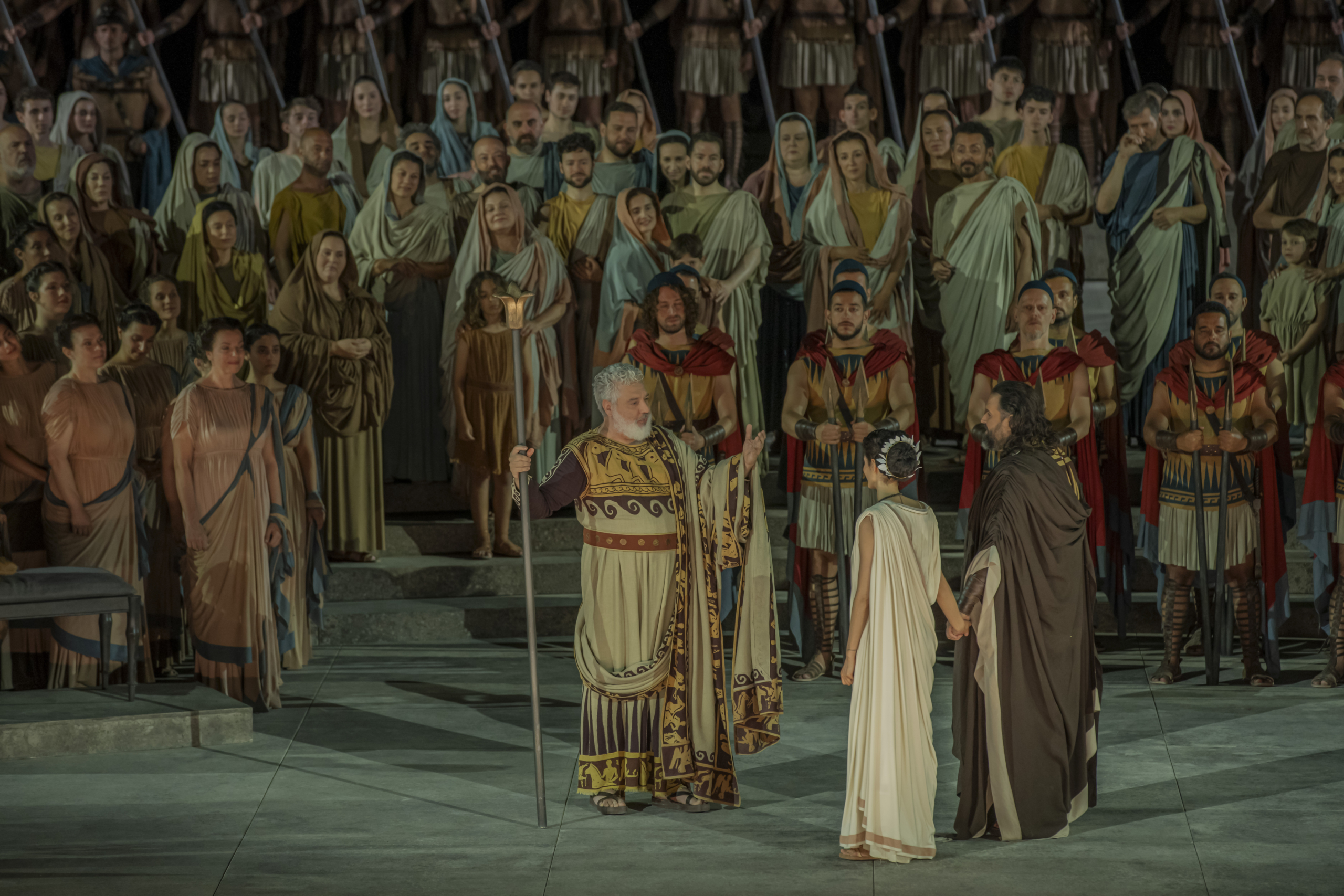
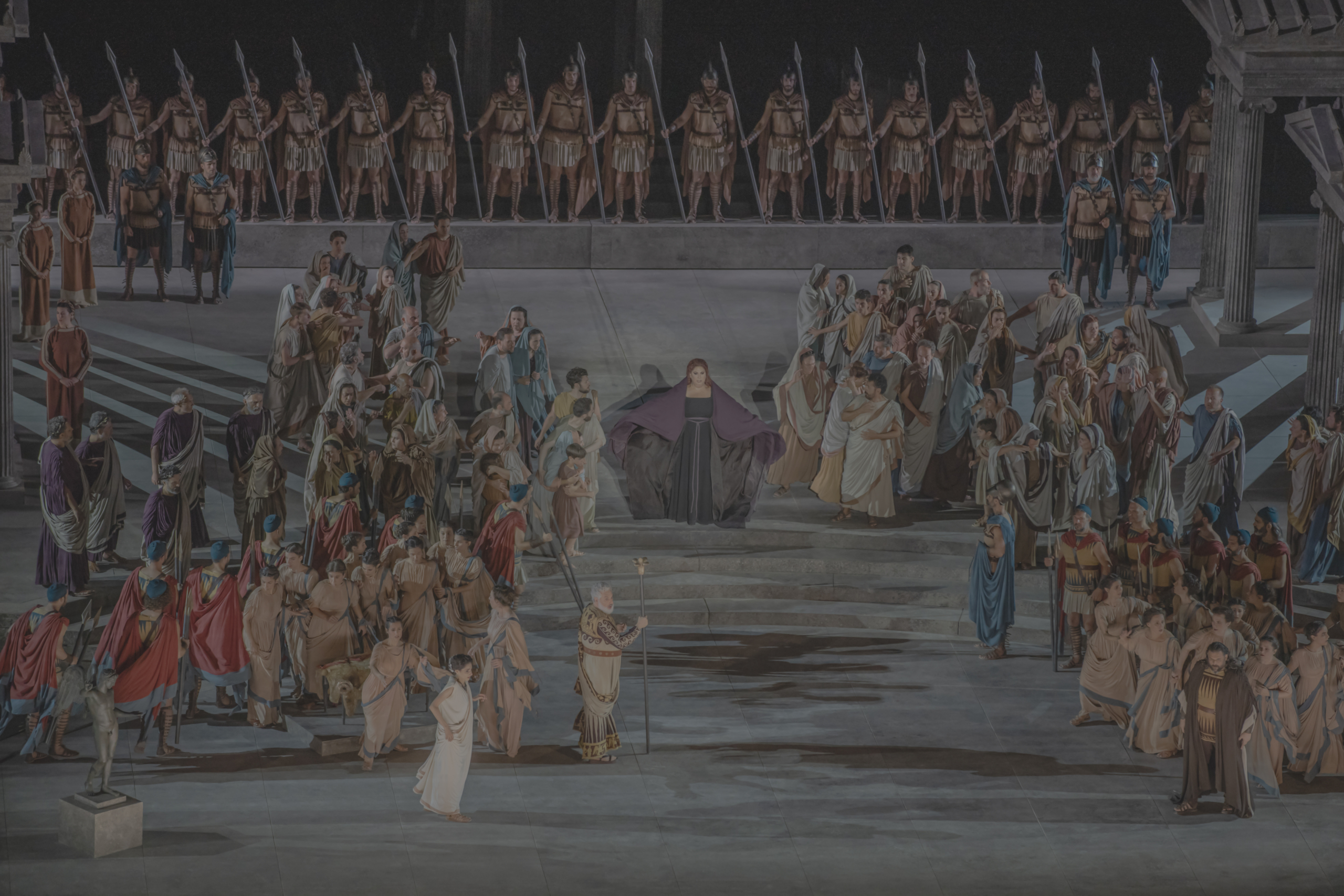
I attended the premiere of the recent revival, which took place on June 20. The creative team that undertook the task of reviving the historic production under the artistic direction of Giorgos Koumendakis—Panagis Pagoulatos (stage direction), Lili Pezanou (set design), Tota Pritsa (costume design), Gianna Filippopoulou and Kelli Zarbela (choreography), alongside Christos Tziogkas (lighting design)—presented a highly convincing result. Crafted with care and sensitivity, it offered today’s audience a clear image of the original staging. The latter drew its aesthetic from the productions of ancient tragedies of that era, featuring beautiful, antique-style sets and costumes. Notably, the elegant taste and visual aesthetic of Yannis Tsarouchis seemed to be fully preserved and highlighted. It is worth mentioning that among the members of the audience were a few individuals who remembered attending the 1961 production at a very young age and emotionally recalled those unique moments.
Just as in the initial staging, the cast for this revival was assembled from distinguished Greek and international singers.
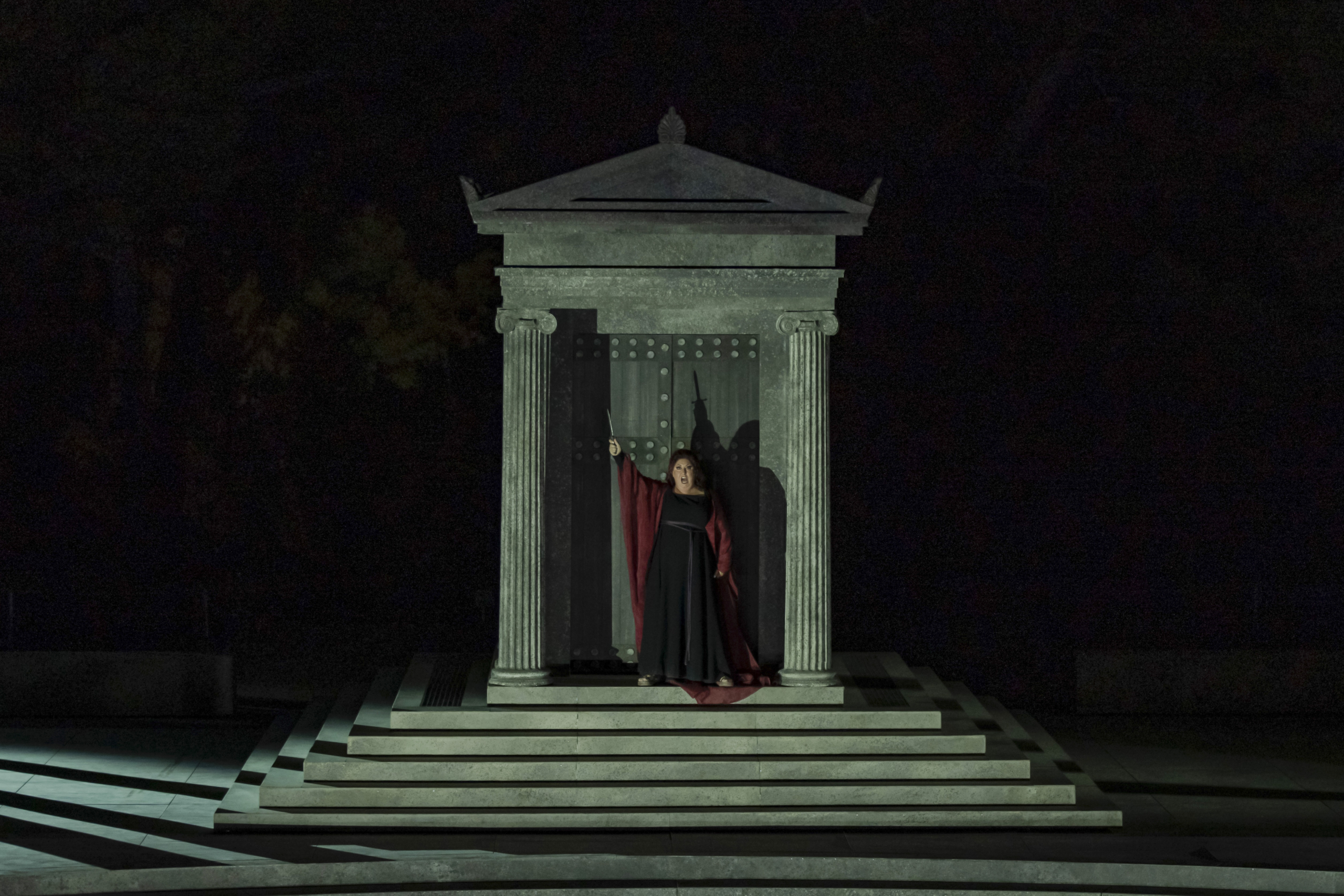
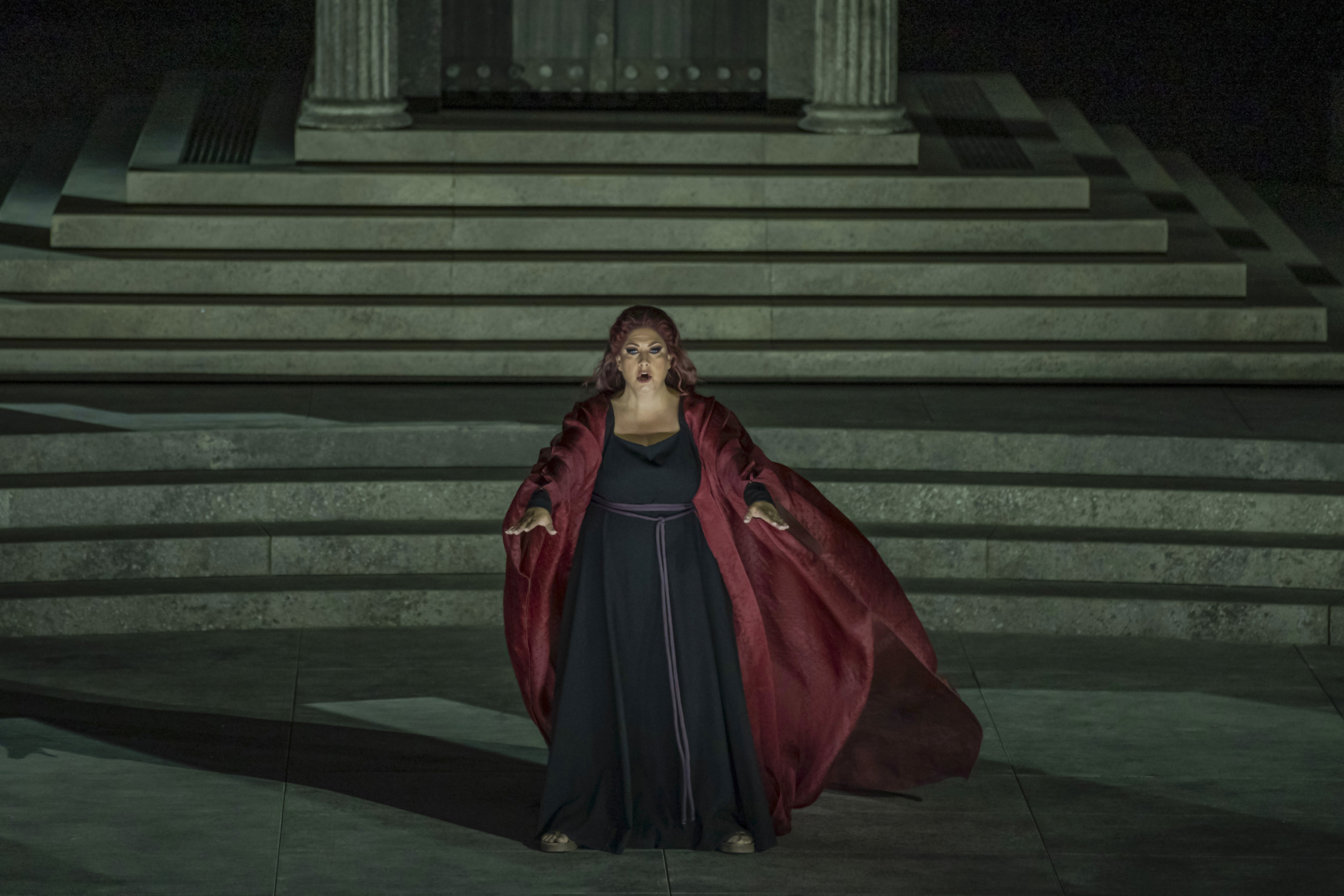
The acclaimed Italian soprano Anna Pirozzi, who in the past has taken part in Greek National Opera productions, performed the title role with commanding authority, an imposing stage presence, and a volcanic dramatic soprano voice. Pirozzi proved exceptionally equipped for the heroine’s grueling technical and psychological demands. Cherubini’s score requires an interpreter of extraordinary artistic dimensions, and Pirozzi met every challenge with stunning results. Her expressive intensity, seamless breath control in expansive phrases, pinpoint tonal accuracy, and brilliant vocal projection left a lasting impression, particularly in the first-act aria Dei tuoi figli la madre and in the grand final scene of the second act, as well as in the psychologically charged and desperately anguished third-act aria, Del fiero duol che mi divora.
As Neris, Russian mezzo-soprano Alisa Kolosova was no less captivating. With exquisite refinement, she captured the quiet dignity, reason, and fierce devotion of Medea’s faithful confidante. Kolosova won immediate admiration through her rich vocal timbre, a warm middle register, complete ease across her entire range, and an unshakeable technical foundation. Her delivery of the character’s singular second-act aria, Solo un pianto, was a paragon of controlled pathos, conveying a profound sense of melancholy. Her performance was beautifully mirrored by the orchestra’s principal bassoonist, Sonja Piesk, who shaped the extensive obbligato lines with remarkable sensitivity and delicacy.
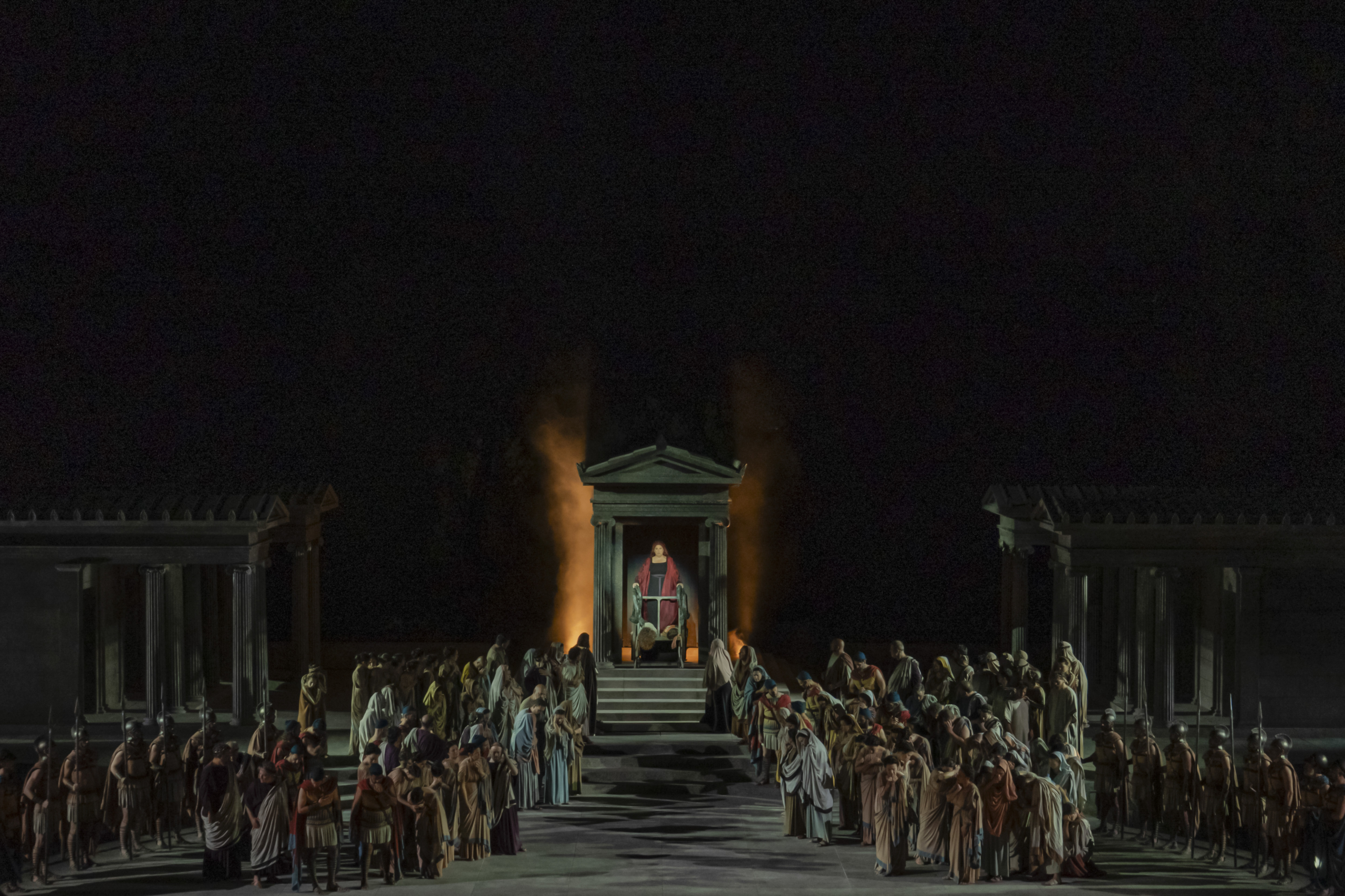
As Creon, King of Corinth, Tassis Christoyannis brought an imposing dignity to the stage, elevated by his crisp diction and renowned innate musicality.
Danae Kontora delivered a consistent and stylishly assured Glauce, deploying a fresh, vibrant instrument with remarkable ease in her upper register. Her rendition of the first-act aria O Amore, vieni a me was characterised by a delightful, sparkling refinement, engaging in an exemplary dialogue with the talented flutist Theodoros Mavrommatis, who performed his own solo with distinct precision and brio.
The shorter roles were carried by Giannis Stamatakis (Leader of the Guard), Aimilía Tsimidakí (First Handmaiden), and Eirini Athanasiou (Second Handmaiden), who all delivered reliable performances.
The Orchestra and Chorus of the GNO performed with impressive responsiveness, expressive immediacy, and attention to text and score. The players were particularly compelling during the famous overture, infusing the opening bars with a heavy, tragic weight that perfectly foreshadowed the impending doom.
At the podium, Jacques Lacombe conducted by underlining the score’s dramatic tension and supporting the singers with experience and stability. The Canadian maestro adopted fluid tempos and adequately highlighted the musical-dramatic material through which Cherubini ingeniously shapes each character of this masterpiece.