

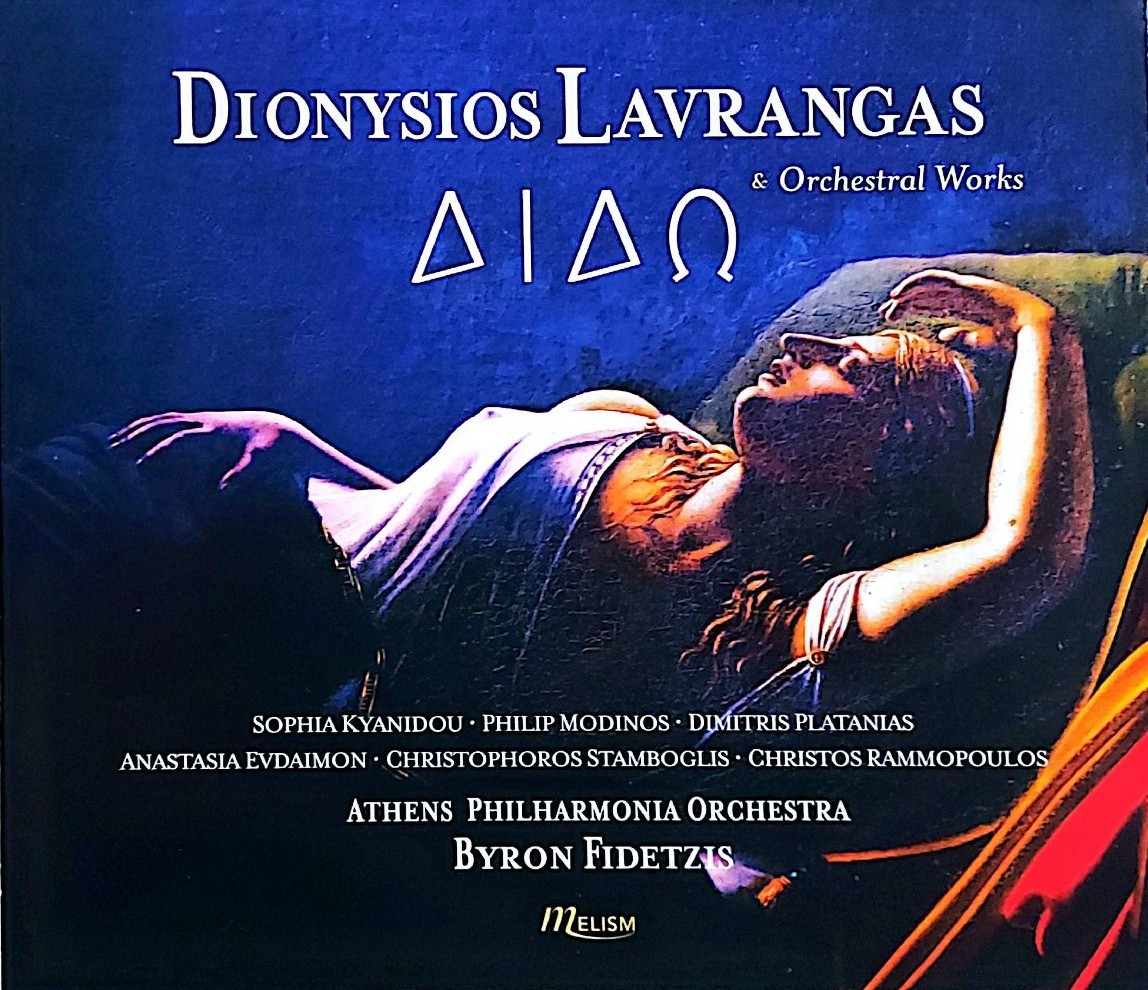
Τhe Academy of Athens hosted οn 2 April 2026, the presentation of the double CD “Dionysios Lavrangas, Dido & Orchestral Works.” The release, issued by Melism Records (MLS 057, 058, 059) in 2025, is accompanied by a bilingual booklet in Greek and English containing historical and analytical commentary on the works, with texts by Byron Fidetzis and the late Olympia Psychopedis-Frangou, as well as the libretto of the opera Dido.
The performance of this emblematic work brings together, under the direction of the tireless advocate of Greek music and highly experienced conductor Byron Fidetzis, the Athens Philarmonia Orchestra — renowned for its specialization in the Greek repertoire — alongside an outstanding cast of soloists: Sophia Kyanidou (Dido, queen of Carthage, soprano), Anastasia Evdaimon (Anna, and her sister, Αstarche, mezzo-soprano), Philip Modinos (Aeneas, son of Anchises, Κing of Troy, tenor), Dimitris Platanias (Achates, companion of Aeneas, baryton), Christophoros Stamboglis (Antheus, companion of Aeneas, bass), Christos Rammopoulos (Ascales, a warrior herald, Cleanthos, baryton). They are joined by the City of Athens Choir, performing the roles of Dardanians, Carthaginians, maidens, priestesses, and the people, under the direction of choirmaster Stavros Beris.
Particularly noteworthy is the painstaking and rigorously documented restoration of the surviving sources undertaken by Professor Nikos Maliaras and the director Byron Fidetzis. Their scholarly work has resulted in a revised, critically established, and lucid musical text, ensuring not only the reliability and significance of the present recording, but also providing a secure foundation for future performances of the work. Equally striking is the stylistic coherence achieved by soloists, orchestra, and choir in relation to the historical idiom and aesthetic character of the composition, while the clarity of diction throughout renders the dramatic action effortlessly comprehensible.
The CD further includes orchestral and chamber works by Dionysios Lavrangas, several of them appearing here in their first recording: First Hellenic Suite (1903), Second Hellenic Suite (1922), Introduction and Fugue on two Hellenic themes [1918], Capriccio for violin on two Hellenic themes (1921), Little Suite for Strings and harp (1913–1919), Romanesca (1924), Two Lyrical Intermezzi for Harp and Strings (1885, 1887), Symphonic Prelude from the Opera “Life is a dream,” Seguidilla, Jota Navarra, The Maiden Sleeps. The soloists in these works are Martha Arapis (soprano), Yareslav Tokarev (violin), and Renato Ripo (cello).
Among these compositions, the iconic First Hellenic Suite stands out as one of the defining works of the Greek National School, while the Second Hellenic Suite occupies an equally important position within the composer’s symphonic output. The Introduction and Fugue on two Hellenic themes — a work once performed by eminent conductors including Dimitri Mitropoulos, later believed lost during the period 1950–1955, and ultimately recovered through the research of Byron Fidetzis — constitutes a major contribution to the Greek orchestral repertoire. Equally significant is the Capriccio for violin on two Hellenic themes, which, according to current research, appears to be the earliest concerto-like work for solo violin and orchestra by a Greek composer.
The Little Suite for Strings and Harp, a three-movement work in a neoclassical idiom, the orchestral Romanesca, based on an original theme drawn from Romanian folk tradition and reflecting the composer’s lived musical experiences, and the Two Lyrical Intermezzi for Harp and Strings, exquisite examples of orchestral operatic interludes, further reveal the breadth of Lavrangas’s stylistic palette. Also included are the Symphonic Prelude from the –lost youthful– Opera “Life is a Dream,” the Spanish-coloured orchestral miniatures Jota Navarra and Seguidilla — whose restoration and preservation are discussed in detail in the accompanying booklet — and finally the orchestral song The Maiden Sleeps on a poem by Ioannis Polemis.
The exceptional quality of the recording itself contributes decisively to the production’s overall result, which is of the highest artistic and technical standard.
Magdalini Kalopana
