

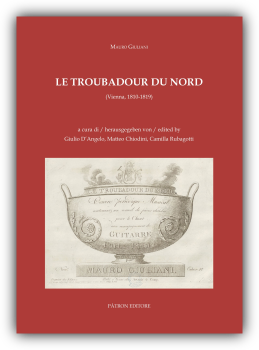
Βιβλιοπαρουσίαση: Mauro Giuliani, Le Troubadour du Nord, Giulio D’Angelo, Matteo Chiodini, Camilla Rubagotti (επιμ.), Μπολόνια: Patron, 2024.
Μία υποδειγματική κριτική και ομοιότυπη (facsimile) έκδοση κυκλοφόρησε στα τέλη του 2024 και περιήλθε στα χέρια της γράφουσας σε αριθμημένο αντίτυπο (19ο από 200). Και οι τρεις επιμελητές είναι συνδεδεμένοι με το Ωδείο Giuseppe Tartini της Τεργέστης: ο Giulio D’Angelo, Καθηγητής Ιστορίας και Αισθητικής της Μουσικής και Συντονιστής του Κέντρου τεκμηρίωσης και μελέτης του δεξιοτέχνη βιολονίστα και συνθέτη G. Tartini “Bruno e Michèle Polli”· o Matteo Chiodini, σολίστ και Καθηγητής κιθάρας· η Camilla Rubagotti, Διδάκτωρ Μουσικολογίας, απόφοιτη του Ωδείου. Οι επιμελητές ανακάλυψαν τα μοναδικά σωζόμενα αντίτυπα των δώδεκα βιβλίων για κιθάρα –ή για fortepiano– τα οποία εξέδωσε στον οίκο Artaria μεταξύ 1810 και 1819 στη Βιέννη ο ιταλός κιθαριστής και συνθέτης Mauro Giuliani. Σημειώνεται πως το μοναδικό αντίτυπο του πρώτου εκ των δώδεκα βιβλίων εντοπίζεται στη Bibliotheca Mozartiana (ταξινομικός αριθμός: Rara Sbd 70, 1an), ενώ τα υπόλοιπα ένδεκα τετράδια φυλάσσονται στη Wienbibliothek I, Rathaus (ταξινομικός αριθμός: MC – 1315). Τα μουσικά κείμενα μελετήθηκαν και σχολιάστηκαν κριτικά σε ξεχωριστό τόμο 235 σελίδων, ενώ τα δώδεκα τετράδια με τα έργα του Giuliani αδειοδοτήθηκαν από τους φορείς που διασώζουν το πρωτότυπο υλικό για την ομοιότυπη επανακυκλοφορία τους. Εν συνόλω, κριτικός τόμος και δώδεκα ομοιότυπα περιέχονται σε καλαίσθητο χάρτινο φάκελο με τα στοιχεία της έκδοσης.
Ο Mauro Giuseppe Sergio Pantaleo Giuliani (Bisceglie, 1781 – Νάπολη, 1829) υπήρξε κιθαριστής και συνθέτης του 19ου αιώνα, η φήμη του οποίου εδραιώθηκε στη Βιέννη κατά την περίοδο (1806-1819). Η σειρά των εκδοθέντων τετραδίων του με τίτλο Le troubadour de Nord περιέχει γνωστά έργα της εποχής του, προερχόμενα τόσο από την έντεχνη όσο και από τη δημοφιλή μουσική, προσαρμοσμένα ή και διασκευασμένα από τον ίδιο για φωνή ή φωνές και συνοδεία κιθάρας ή fortepiano. Διευκρινίζεται στο σημείο αυτό πως ως fortepiano χαρακτηρίζεται η πρώιμη κατασκευή του πιάνου (18ος-19ος αιώνας), η οποία φέρει δερμάτινο κάλυμμα των σφυριών, λεπτές χορδές όπως στα τσέμπαλα, ξύλινο σκελετό, μικρότερο σε έκταση και ελαφρύτερο κλαβιέ, με απλή επαναφορά των πλήκτρων. H κιθάρα από την άλλη πλευρά, υπήρξε δημοφιλές όργανο κατά την περίοδο του Μπαρόκ τόσο στην Ιταλία, όσο και τη Γαλλία και φυσικά στην Ισπανία, που απετέλεσε στη συνέχεια το επίκεντρο των κατασκευαστικών εξελίξεων και του συνθετικού και εκτελεστικού ενδιαφέροντος του οργάνου.
Ο κριτικός τόμος περιέχει εισαγωγή του Frédéric Zigante, και τρία κεφάλαια των επιμελητών της έκδοσης: Giulio D’Angelo, “Le Troubadour du Nord. Mauro Giuliani’s and Domenico Artaria’s editorial edventure” [Le Troubadour du Nord. Το εκδοτικό εγχείρημα των Mauro Giuliani’s και Domenico Artaria] · Matteo Chiodini, “Musical Review and Commentary” [Κριτική αναθεώρηση και σχολιασμός]· Camilla Rubagotti, “Physical Description of the Volumes of Le Troubadour du Nord preserved at the Wienbibliothek im Rathaus in Vienna” [Περιγραφή των φυσικών τεκμηρίων των τόμων του Le Troubadour du Nord που φυλάσσονται στη Wienbibliothek im Rathaus στη Βιέννη], όπως επίσης και κείμενο του Stefan Engl με τον τίτλο “The Viennese Music Publishers in the Heyday of Viennese Guitar Music between 1800 and 1830” [Οι βιεννέζοι μουσικοί εκδότες στην ακμή της βιεννέζικης μουσικής για κιθάρα μεταξύ 1800 και 1830]. Η τρίγλωσση απόδοση –στην ιταλική, γερμανική και αγγλική γλώσσα– των κριτικών κειμένων και του περιέκτη όλης της έκδοσης αποτελεί προτέρημα που μπορεί να ενισχύσει ιδιαιτέρως τη σημασία και την απήχηση της έκδοσης. Στο σημείο αυτό κρίνεται σκόπιμο να προστεθεί πως η Camilla Rubagotti έχει πραγματοποιήσει τη μεταγραφή και μετάφραση όλων των λεκτικών κειμένων, σε επιμέλεια του Royston Vince.
Η έκδοση επιτελεί τρεις σημαντικές λειτουργίες. Αφενός διασώζει ένα ολοκληρωμένο συνθετικό πόνημα του 19ου αιώνα, αποκαθιστά εκδοτικές αβλεψίες της πρώτης και μοναδικής έκδοσης και το προτείνει για επανένταξη στο σύγχρονο ρεπερτόριο. Αφετέρου, επαναδιαπραγματεύεται τον ρόλο του σημαντικότερου Ιταλού συνθέτη και εκτελεστή κιθάρας, ο οποίος έδρασε στο μουσικό κέντρο της Ευρώπης κατά τις αρχές του 19ου αιώνα, φωτίζοντας επιπλέον ιστορικά τη διαμόρφωση του ρεπερτορίου της κιθάρας πριν την άνοδο της ισπανικής σχολής. Τέλος, αναδεικνύει τον κομβικό ρόλο της αρχειακής έρευνας και της επανατοποθέτησης των ιστορικών τεκμηρίων σε διάλογο με το ευρύ κοινό. Η έκδοση αυτή μπορεί να λειτουργήσει ως καλή πρακτική για αντίστοιχο υλικό το οποίο εντοπίζεται και διασώζεται πλέον με γοργούς ρυθμούς στους αντίστοιχους ιδιωτικούς και δημόσιους φορείς της Ελλάδας (Αρχείο Ελλήνων Μουσουργών Θωμά Ταμβάκου, Μουσική Βιβλιοθήκη Λίλιαν Βουδούρη, «Πολύμνια» του Εργαστηρίου Ελληνικής Μουσικής του Εθνικού και Καποδιστριακού Πανεπιστημίου Αθηνών).
Μαγδαληνή Καλοπανά,
Μουσικολόγος, Δρ.
Book Review: Mauro Giuliani, Le Troubadour du Nord, Giulio D’Angelo, Matteo Chiodini, Camilla Rubagotti (edit.), Bologna: Patron, 2024.
A model critical and facsimile edition was published in late 2024 and came into the author’s possession in a numbered copy (no. 19 of 200). All three editors are affiliated with the Giuseppe Tartini Conservatory of Trieste: Giulio D’Angelo, Professor of Music History and Aesthetics and Coordinator of the Documentation and Research Centre dedicated to the virtuoso violinist and composer G. Tartini, “Bruno e Michèle Polli”; Matteo Chiodini, soloist and Professor of Guitar; and Camilla Rubagotti, PhD in Musicology and a graduate of the Conservatory.
The editors discovered the only surviving copies of the twelve books for guitar—or fortepiano—issued by the Artaria publishing house in Vienna between 1810 and 1819 and composed by the Italian guitarist and composer Mauro Giuliani. It should be noted that the sole surviving copy of the first of the twelve books is preserved at the Bibliotheca Mozartiana (shelfmark: Rara Sbd 70, 1an), while the remaining eleven booklets are housed at the Wienbibliothek im Rathaus (shelfmark: MC–1315). The musical texts were studied and critically annotated in a separate volume of 235 pages, while the twelve booklets containing Giuliani’s works were licensed by the institutions safeguarding the original material for their facsimile reissue. Overall, the critical volume and the twelve facsimiles are presented together in an elegant paper slipcase bearing the publication details.
Mauro Giuseppe Sergio Pantaleo Giuliani (Bisceglie, 1781 – Naples, 1829) was a nineteenth-century guitarist and composer whose reputation was firmly established in Vienna during the period 1806–1819. His series of published booklets entitled Le troubadour du Nord contains well-known works of his time, drawn from both art music and popular repertoire, adapted or arranged by Giuliani himself for solo voice or voices with accompaniment by guitar or fortepiano. At this point it should be clarified that the term fortepiano refers to the early form of the piano (eighteenth–nineteenth century), characterized by leather-covered hammers, thin strings similar to those of the harpsichord, a wooden frame, a smaller range, and a lighter keyboard with simple key return. The guitar, on the other hand, was a popular instrument during the Baroque period in Italy and France, and, of course, in Spain, which subsequently became the focal point of the instrument’s constructional developments as well as of compositional and performance interest.
The critical volume includes an introduction by Frédéric Zigante and three chapters by the editors of the edition: Giulio D’Angelo, “Le Troubadour du Nord. Mauro Giuliani’s and Domenico Artaria’s editorial adventure”; Matteo Chiodini, “Musical Review and Commentary”; and Camilla Rubagotti, “Physical Description of the Volumes of Le Troubadour du Nord preserved at the Wienbibliothek im Rathaus in Vienna”. It also contains a contribution by Stefan Engl entitled “The Viennese Music Publishers in the Heyday of Viennese Guitar Music between 1800 and 1830”. The trilingual presentation—in Italian, German, and English—of both the critical texts and the accompanying material of the entire edition constitutes a significant asset, one that considerably enhances the publication’s importance and impact. At this point it is worth noting that Camilla Rubagotti carried out the transcription and translation of all the verbal texts, edited by Royston Vince.
This edition fulfils three important functions. On the one hand, it preserves an entire nineteenth-century compositional corpus, corrects editorial oversights of the first and only historical edition, and proposes the works for reintegration into the contemporary repertoire. On the other hand, it reassesses the role of the most significant Italian composer and guitarist active in the musical centre of Europe in the early nineteenth century, while also shedding light on the historical formation of the guitar repertoire prior to the rise of the Spanish school. Finally, it highlights the pivotal role of archival research and the recontextualisation of historical sources in dialogue with a broader public. This publication may thus serve as a model of good practice for similar material that is now being identified and preserved at an increasing pace within both private and public institutions in Greece (the Archive of Greek Composers “Thomas Tamvakos”, the Lilian Voudouri Music Library, and “Polymnia” of the Laboratory for the Study of Greek Music at the National and Kapodistrian University of Athens).
Magdalini Kalopana
Musicologist, PhD.
