

Meanderings
The Music Biennale Zagreb, a festival with a 64-year history, is currently in its 33rd edition. This pan-European event is dedicated to all genres of art music, with a particular focus on 20th-century repertoire and experimental creation. The festival is supported, among others, by the Croatian Composers’ Society, founded by composer Milko Kelemen.
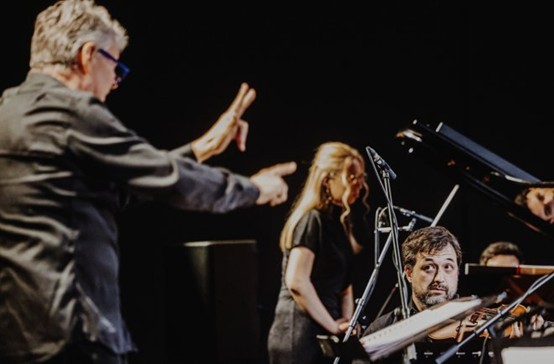
It is one of the few long-standing festivals of art music with a consistent emphasis on contemporary composition. We attended the concert on April 9, 2025 (Vatroslav Lisinski Concert Hall / Small Hall), which featured the following program:
Juraj Marko Žerovnik, Coalescence, for chamber ensemble; Milko Kelemen, Die sieben Plagen, for solo voice; Uroš Rojko, Neofonia, for chamber ensemble; Jawher Matmati, Katharsis, for alto saxophone, accordion and cello; Ivo Malec, Miniatures pour Lewis Carroll, for chamber ensemble; Maja Bosnić, A bit less DEATH and GORE, for chamber ensemble.
Soloists for the evening were soprano Lidija Horvat Dunjko and bass-baritone Marko Špehar. The “Cantus Ensemble” was conducted by Berislav Šipuš.
A notable common thread across all the works—each of which received its premiere at this concert—was the contemporary re-examination of musical avant-gardism through tonal means; in other words, a renewed engagement with postwar modernism from a contemporary perspective. The composers involved raised pertinent questions of postmodernism through their individual artistic lenses: the use of innovative techniques was not treated as an end in itself, but rather as one tool among many; similarly, tonality was not employed dogmatically, but rather emerged as a dense and multifaceted network of expressive possibilities. Particularly characteristic was the interweaving of modernist pitch organization (pitch class sets) with clearly articulated tonal references, featuring distinct tonal centers that emerged naturally and effortlessly.
Of course, this type of writing is not new; it has been previously explored (e.g., by György Ligeti, Alfred Schnittke, Krzysztof Penderecki). What is noteworthy, however, is that amid the frequently radical stylistic pluralism of the 21st century, one may begin to discern a tendency—a shared aesthetic orientation toward which a significant portion of contemporary compositional practice appears to be gravitating.
Particularly emblematic of this direction was the final work on the program, by Serbian composer Maja Bosnić. Incorporating multimedia elements (chamber ensemble and audiovisual material/video) and engaging with timely and sensitive global socio-political concerns, the work achieved—if not an ideal synthesis—certainly an affective catharsis, realized through the convergence of musical discourse, musicians, audience, and broader society.
Magdalini Kalopana, Musicologist, PhD.
Η Μουσική Biennale του Zagreb, μία διοργάνωση που μετρά ήδη 64 χρόνια παρουσίας, διανύει φέτος την 33η περίοδό της. Ένα πανευρωπαϊκής εμβέλειας φεστιβάλ, αφιερωμένο σε όλα τα μουσικά είδη της έντεχνης μουσικής, με εστίαση στο ρεπερτόριο του 20ού αιώνα και την πειραματική δημιουργία. Η διοργάνωση στηρίζεται μεταξύ άλλων από την Ένωση Κροατών Συνθετών, με ιδρυτή τον συνθέτη Milko Kelemen.
Ένα από τα λίγα πολυετούς παρουσίας φεστιβάλ έντεχνης μουσικής με εστίαση στη σύγχρονη δημιουργία. Παρακολουθήσαμε τη συναυλία της 9ης Απριλίου 2025 (Vatroslav Lisinski Concert Hall / Small Hall) με το ακόλουθο πρόγραμμα:
Juraj Marko Žerovnik, Coalescence, for chamber ensemble· Milko Kelemen, Die sieben Plagen, for solo voice· Uroš Rojko, Neofonia, for chamber ensemble· Jawher Matmati, Katharsis, for alto saxophone, accordion and cello· Ivo Malec, Miniatures pour Lewis Carroll, for chamber ensemble· Maja Bosnić, A bit less DEATH and GORE, for chamber ensemble. Σολίστ της βραδιάς ήταν η Lidija Horvat Dunjko, soprano και ο Marko Špehar, bas-bariton. Το ορχηστρικό σύνολο “Cantus Ensemble” διηύθυνε ο Berislav Šipuš.
Ενδιαφέρον κοινό στοιχείο σε όλα τα έργα –τα οποία σημειωτέον πως έκαναν πρεμιέρα στη συγκεκριμένη συναυλία– υπήρξε η σύγχρονη επαναδιαπραγμάτευση της μουσικής πρωτοπορίας με τονικούς όρους· με άλλα λόγια, η επαναπροσέγγιση του μεταπολεμικού μοντερνισμού με σύγχρονους όρους. Οι συνθέτες και οι συνθέτριες έθεσαν εύστοχα ζητήματα του μεταμοντερνισμού μέσα από την προσωπική τους οπτική: η χρήση καινοτόμων τεχνικών δεν ήταν αυτοσκοπός, αλλά μέσο ανάμεσα σε άλλα· ομοίως, η χρήση της τονικότητας δεν υπήρξε μονόδρομος, αλλά ένα πυκνό δίκτυο με πολλαπλές εκφράσεις. Χαρακτηριστική δε υπήρξε η συνύφανση της οργάνωσης του νομικού υλικού του μοντερνισμού (pitch class sets) με σαφείς τονικές αναφορές, με ευδιάκριτα τονικά κέντρα, το οποία πρόβαλαν την ύπαρξή της φυσικά και αβίαστα. Φυσικά, το είδος αυτής της γραφής δεν είναι νέο· έχει ήδη δοκιμαστεί στο παρελθόν (György Ligeti, Alfred Schnittke, Krzysztof Penderecki). Σημαντικό στοιχείο αποτελεί ωστόσο το γεγονός πως μέσα στον ακραίο συχνά υφολογικό πλουραλισμό του 21ου αιώνα, αρχίσει να διαφαίνεται ίσως μία τάση, μία κοινή συνισταμένη στην οποία σημαντικό μέρος της σύγχρονης δημιουργίας φαίνεται να συγκλίνει.
Ιδιαίτερα αντιπροσωπευτικό σε αυτή την κατεύθυνση υπήρξε το τελευταίο έργο της συναυλίας, της σέρβας συνθέτριας Maja Bosnić. Το έργο, με χρήση πολλαπλών μέσων (ορχηστρικού συνόλου και οπτικοακουστικού υλικού/video) και τη θέση επίκαιρων και ευαίσθητων κοινωνικών ζητημάτων παγκόσμιου ενδιαφέροντος πέτυχε αν όχι την ιδανική σύνθεση, σίγουρα την ψυχαγωγική κάθαρση μέσα από τον συγκερασμό των απόψεων μουσικής, μουσικών, ακροατηρίου και ευρύτερου συνόλου.
